



Choosing Between Mechanical and Pilot Control — What the Joystick Actually Changes
New operators notice the difference immediately; experienced operators can usually feel it within the first bucket cycle. Mini excavator pilot control does not just change the weight of the joystick — it changes what the joystick is actually doing inside the hydraulic circuit, and that mechanical difference has downstream effects on precision, fatigue, and attachment compatibility that accumulate over a shift, a week, and a machine's working life. Understanding what separates the two control architectures is practical knowledge for anyone specifying compact excavators for professional use.
The 15 serious above — is built around pilot control as a standard or optional specification. All are capable control systems for their respective design intent, but they serve different work profiles, and choosing the wrong architecture for the primary application is a specification mistake that shows up in operator output quality and end-of-day fatigue data.
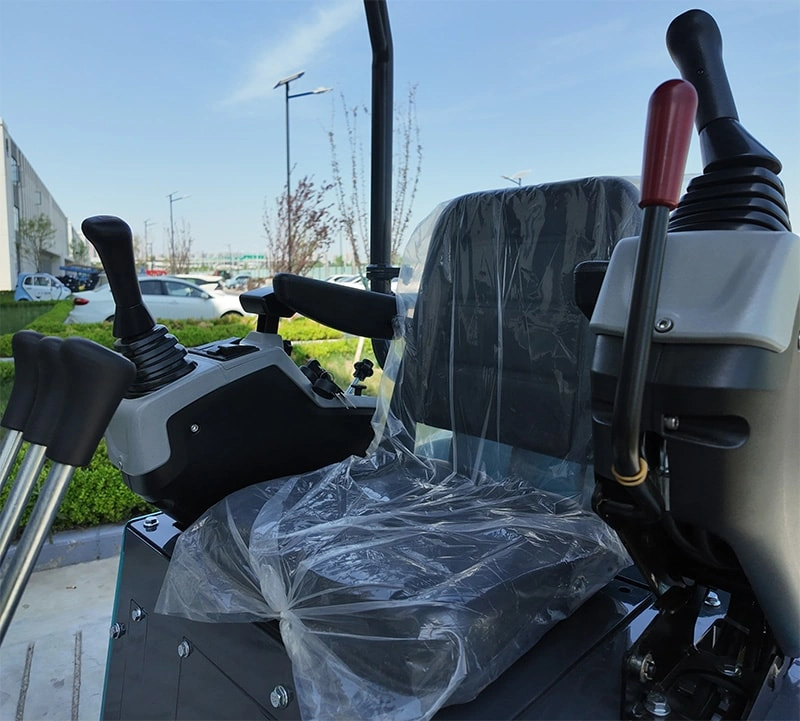
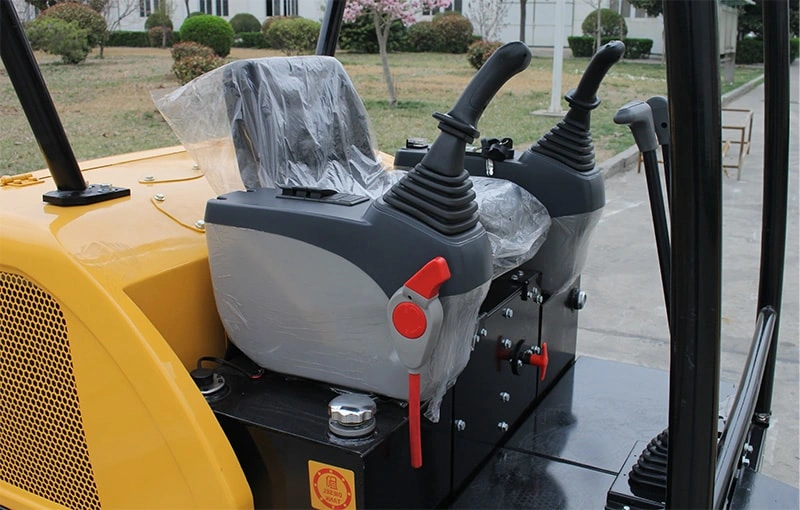
Mini Excavator 18Serious — Hydraulic Pilot Joystick Handle Detail
What Mechanical Control Actually Does Inside the Valve
In a mechanical joystick system, moving the joystick physically displaces a cable or push-rod that is directly connected to the spool inside the multi-way control valve. The spool moves in proportion to the joystick displacement, opening or closing the oil passage to each cylinder or motor. The operator's hand force is the force that moves the spool — which means the joystick is both the input device and the actuator.
This has consequences. The joystick on a mechanical control system has a finite lever ratio — the distance the spool can travel sets the maximum valve opening, and the feel of the joystick changes with oil temperature, spool condition, and the load on the circuit being controlled. In cold conditions, when the hydraulic oil is thick, the valve spool resists movement more than when the oil is at operating temperature, and the joystick feels heavier. In high-load conditions — crowding against hard clay — the back-pressure in the cylinder circuit can push back through the valve spool and into the joystick, creating a resistance force that the operator must work against.
For straightforward single-function digging on compact sites, this is entirely manageable. The 06 series and 10 series mechanical control systems are appropriate for their machine class and their primary use case. The problem is that mechanical control limits how fine the control can be — because the operator's hand is the servo mechanism, the minimum valve opening is constrained by how steadily a hand can hold a position while simultaneously controlling other machine functions.
What Pilot Control Changes — and Why the Difference Is Felt Immediately
In a mini excavator pilot control system, the joystick does not move the main valve spool directly. Instead, it controls a small pilot valve that sends a low-pressure hydraulic signal — typically 25 to 40 bar — to the main control valve. The main valve spool moves in response to this pilot signal, with the hydraulic pressure doing the work of spool actuation rather than the operator's hand.
The consequence is that the joystick requires almost no physical force to operate. The operator is modulating a pilot pressure signal rather than pushing a mechanical linkage, which means the control feel is consistent regardless of the main circuit load, oil temperature, or machine angle. The 13K Pro with hydraulic pilot handle delivers this characteristic: fine grading movements that would cause forearm fatigue on a mechanical control machine become achievable with fingertip pressure over extended periods.
Response linearity is also improved in pilot control systems. Mechanical linkages have dead zones — the initial joystick movement where the spool hasn't opened far enough to produce visible machine movement. In a pilot system, the pilot signal builds proportionally from the first millimetre of joystick travel, which means the machine begins to respond earlier and more predictably to small inputs. This is the characteristic that makes pilot-controlled machines noticeably better at fine grade work, precise attachment positioning, and any task where the operator is trying to match a target position rather than just move material.
Two-Sided Pilot Control — The Configuration That Changes Attachment Compatibility
Some machines in the range — specifically the 13K Pro and 18K Pro — are available with two-sided pilot control. This configuration places pilot control functions on both the right and left joystick handles, and typically frees up the foot pedals for additional functions such as boom lateral swing (where fitted) or attachment auxiliary flow control.
Two-sided pilot control matters most for operators running hydraulic attachments alongside standard excavation functions. When the right-hand pilot joystick controls boom and bucket, and the left-hand pilot joystick controls stick and swing, auxiliary attachment control can be assigned to a thumb button or secondary axis on one of the joysticks rather than requiring a separate foot pedal input. This means the operator can simultaneously control all primary machine functions and the hydraulic attachment without taking either hand off the joystick — an ergonomic improvement that directly increases the speed and precision of attachment-based work cycles.
The practical case where two-sided pilot control is most valuable: hydraulic thumb operation for demolition grab-and-sort work. The operator is controlling boom position, stick crowd, and hydraulic thumb open/close simultaneously. With mechanical control, thumb control requires a separate lever or foot input. With two-sided pilot control, it's a thumb button on the joystick handle — one hand, all three functions, no change in body posture.
Mini Excavator 25Serious — Two-Sided Pilot Control Configuration
Which Work Profile Needs Which Control System
The decision between mechanical and mini excavator pilot control should start with the primary work profile, not the price list. Mechanical control — as found on the Q-series machines — is correct for high-volume, single-function digging where output rate is measured in cubic metres moved per hour and precision grading is not the primary product. Utility trenching in uniform soil, bulk basement excavation, general site clearance — these tasks benefit more from reliable machine weight and track width than from joystick refinement.
Pilot control earns its specification premium when the work involves finishing grade, precision attachment operation, confined-site manoeuvring, or extended daily operating hours where operator fatigue affects output quality in the second half of the shift. Landscaping contractors, service trench installers working to precise invert levels, concrete demolition teams using hydraulic breakers and grabs simultaneously — all of these work profiles benefit from the lighter, more consistent control feel that pilot systems provide.
For buyers evaluating rental fleet machines: pilot control on K-series machines handles a broader range of operators with less training overhead. A less experienced operator on a mechanical control machine fights the joystick resistance and tends to overshoot fine position targets; the same operator on a pilot machine reaches an acceptable precision standard faster. In rental context where you have no control over who operates the machine next, pilot control is a specification that produces more consistently acceptable output across a wider operator skill range.
Maintenance Implications of the Two Control Architectures
Mechanical control systems are simpler to maintain in field conditions. A stiff or imprecise mechanical joystick usually has one of three causes: worn cable sheath, contaminated spool due to inadequate hydraulic filtration, or a bent or misadjusted linkage rod. All three are diagnosable and fixable with basic tools and a hydraulic manual. There are no electronic or hydraulic pilot components to replace.
Pilot control systems require clean hydraulic fluid above all else. The pilot valve operates at low pressure through very tight clearances — smaller particles survive the main circuit filter but can jam a pilot valve spool. The pilot filter (a fine-micron filter on the pilot circuit supply line) must be changed at its specified interval, which is typically shorter than the main return filter interval. Operators who see degraded joystick response on a pilot-control machine — specifically a progressive increase in joystick effort or a delayed main valve response — should check the pilot filter before investigating anything else.
For export markets or remote deployment locations where service infrastructure is limited, the lower parts complexity of mechanical control is a legitimate consideration. For professional contractor use in markets with competent hydraulic service, the maintenance requirement of pilot control is not a barrier — it is a known interval with a known consumable.
Deciding between Q-series mechanical control and K-series pilot control for your application?
JRD Machinery's technical team can walk through the specific work profile requirements — attachments, operator hours per day, ground conditions — and recommend the control configuration that fits. All models CE-certified with full export documentation.
Visit www.jrdmachinery.com to view the full K-series and Q-series specifications, or contact us for a configuration recommendation and quotation.