



Getting Straight Holes Without Stalling — Auger Drill on a Mini Excavator
An auger attachment converts a mini excavator auger drill setup into one of the most versatile post-hole machines available for construction and landscaping work. Fence lines, pergola posts, tree planting, ground anchors, soil sampling — all of these benefit from the speed and consistency of a powered auger over manual digging. But auger performance is not automatic. The two most common complaints about compact excavator auger operation — the auger stalls in dense clay, and the holes come out angled rather than plumb — both have fixable causes, and neither of them is that the machine is too small for the task.
This article covers how the hydraulic auxiliary circuit that drives the auger motor works, how to match flow and pressure to the auger motor's rated requirements, why bit selection changes everything in different soil conditions, and the operating techniques that produce straight, clean holes regardless of whether the soil is sandy loam or compacted fill.
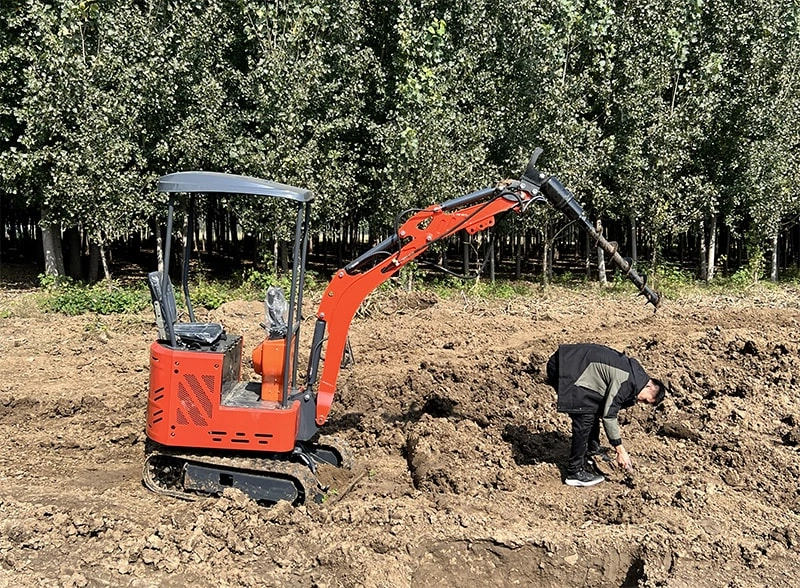
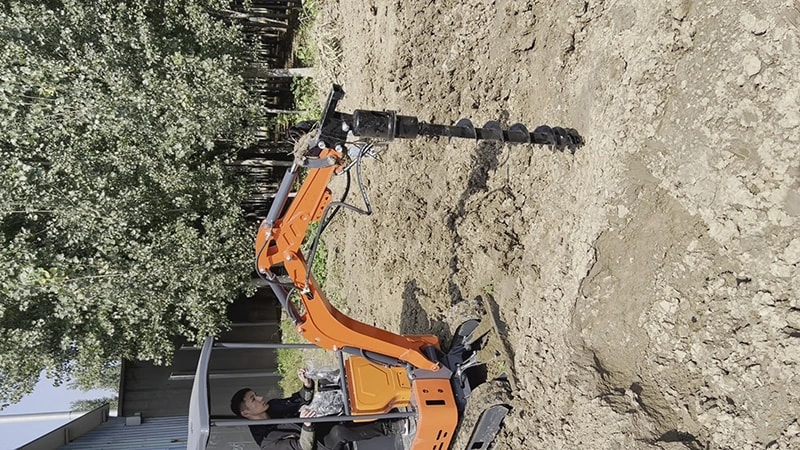
Mini Excavator Spiral Drill Auger Attachment — Post Hole Operation
The Auxiliary Circuit: What Drives the Auger and Why Flow Rate Is the Critical Number
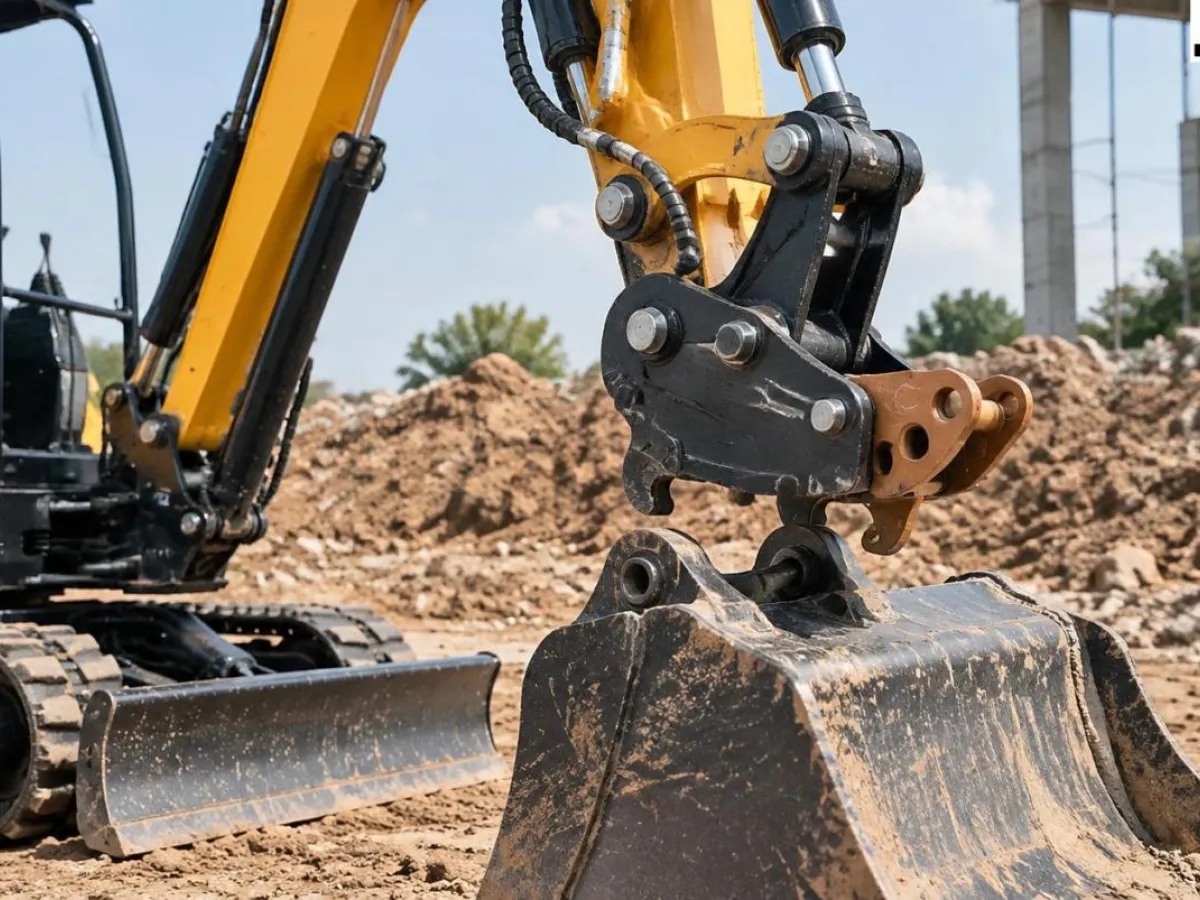
The mini excavator auger drill attachment is powered by the machine's hydraulic auxiliary circuit — a dedicated port on the multi-way valve that provides pressurised flow for attachment motors. The auger drive unit (the motor housing that mounts between the quick coupler and the auger bit) converts that hydraulic flow into rotational torque at the bit.
Every auger motor has a rated flow range — typically expressed as minimum and maximum litres per minute (LPM) — within which it operates efficiently. Below the minimum, the motor doesn't generate enough torque to overcome the soil resistance at the bit face, and the auger stalls. Above the maximum, the excess flow routes through the motor's internal relief valve as heat, without increasing torque, and the circuit temperature rises. Finding the machine's auxiliary flow output and matching it to the auger motor's rated range is the setup step that most operators skip, and it is the cause of most auger stall problems.
On machines with fixed auxiliary flow — including the 10 series, 12Q, and 15Q — the output is set at the factory and cannot be adjusted at the valve. These machines are matched with auger motors spec'd for their flow range at the time of attachment selection. On machines with the Taifeng multi-way valve — the 17 series — the auxiliary flow rate can be adjusted without tools, which allows one machine to drive different auger motor sizes by setting the flow to match each motor's requirement. This flexibility matters for contractors who use the same compact excavator with different auger sizes across different job types.
Bit Selection by Soil Type — The Decision That Determines Whether the Hole Comes Out Right
Auger bit design is optimised for specific soil conditions, and using the wrong bit type in the wrong material is the second most common cause of poor auger performance after incorrect hydraulic flow. The flight pitch (the spiral angle of the helix), the bit cutting head geometry, and the overall diameter all change between soil types.
In soft to medium loam and sandy soils, a standard pitch flight with a fish-tail cutting head works well across the diameter range. The material clears the flutes easily, the bit advances per revolution is consistent, and the hole profile is clean. In clay — especially stiff clay or clay with high stone content — a steeper pitch flight is more effective because it moves more material per revolution before the clay has a chance to squeeze back against the bit. A clay-specific cutting head uses more aggressive leading-edge geometry to shear rather than scrape the material.
In gravel or rocky fill material, a standard flight auger will deflect as it encounters stones, producing a hole that wanders from plumb and a bit that wears unevenly. For this material, a rock auger with tungsten carbide tips is the correct choice. The tungsten carbide tips fracture rock rather than deflecting around it, and the bit maintains vertical progress rather than chasing the path of least resistance through the aggregate. Using a standard auger in rocky fill produces crooked holes and rapid bit wear; a rock bit in the same material produces straight holes at acceptable wear rates.
Technique for Plumb Holes — The Part No One Explains Clearly
Auger holes that come out angled are almost always a technique problem rather than an equipment problem. The causes are: entering the soil at an angle, allowing the bit to walk when it encounters the first resistance, and not maintaining vertical alignment of the auger shaft during the descent.
Correct entry starts before the bit touches the ground. Position the machine so the auger shaft is visually vertical from two directions — from directly in front and from 90° to the side. With pilot control available on machines like the 13K Pro and 17 series, fine boom and stick adjustments can be made with precision to achieve this alignment. On mechanical-joystick machines, it takes more time but the alignment must still be achieved before the bit engages the soil.
Once the bit engages soil, the first 150 mm of descent sets the angle of the entire hole. Apply light crowd pressure (stick force) rather than heavy downward force during this entry phase — let the bit's cutting action pull it down rather than forcing it through. Forcing the bit during initial engagement is what causes the walk that produces angled holes. Once the bit is 200 mm into the ground, the surrounding soil constrains the angle and further deviation is minimal.
For deep holes — 600 mm and beyond — break the descent into 200 mm lifts. After each 200 mm of advance, reverse the rotation briefly and lift the bit out of the hole to clear the cuttings from the flutes. Cuttings that pack in the flute spiral cause torque spikes that the hydraulic motor responds to by stalling. Regular clearing is the difference between consistent hole depth and an auger that stalls at 400 mm in every hole despite having the right flow and pressure settings.
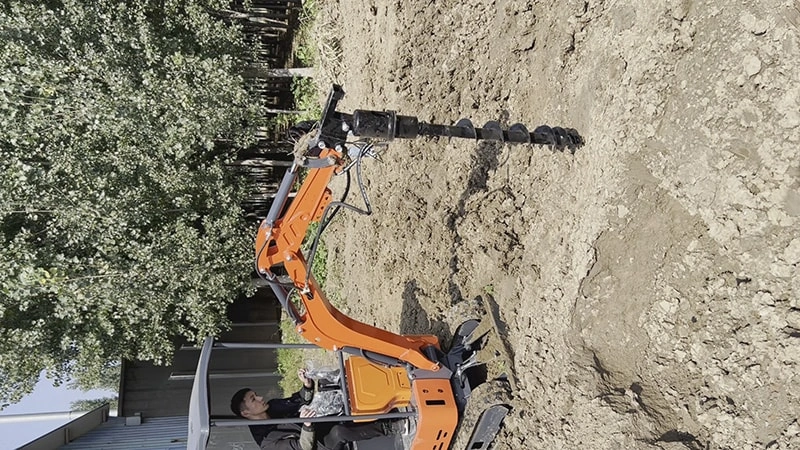
Mini Excavator 08K Series — Auger Operation with Pilot Control Joystick
Matching Machine Weight to Auger Reaction Torque
One aspect of mini excavator auger drill selection that doesn't get enough attention is machine weight relative to auger reaction torque. When a large-diameter auger encounters hard soil, the reaction torque (the rotational force that the soil exerts back against the bit) can be strong enough to rotate the machine's boom assembly against the undercarriage if the machine is not heavy enough to resist it. This manifests as the whole machine rotating slightly with the auger when torque spikes — it looks minor, but it's an indication that the auger size is beyond the machine's capacity to hold position.
The practical guideline: a 150 to 200 mm diameter auger is well within the capacity of the 10 series at 1,000 kg and 6 kN digging force. A 300 mm diameter auger in stiff clay is appropriate for the 13K at 1,100 kg and 11 kN. A 400 mm diameter auger for large planting holes or anchor posts in dense material needs the 17 series at 1,700 kg and 13.5 kN, where the machine weight and auxiliary flow from the Taifeng valve both support the larger drive unit. Running a 400 mm auger on a 1,000 kg machine produces the machine-rotation symptom and the bit never achieves full torque, because the machine is absorbing the reaction force rather than the soil.
For buyers specifying a compact excavator for auger work as a primary use: size the machine to the largest auger you expect to use regularly, not the average. Running a larger machine on smaller auger diameters costs nothing in performance and very little in efficiency. Running a smaller machine at the limits of its capacity for auger reaction torque costs bits, costs hydraulic components from the torque cycling, and produces holes that aren't plumb.
Sourcing compact excavators for auger work, post-hole drilling, or foundation anchor installation?
JRD Machinery supplies CE-certified mini excavators with auxiliary hydraulic circuits and a full attachment range including spiral drill augers in multiple diameter configurations. Our technical team can advise on flow matching for specific auger drive units.
Visit www.jrdmachinery.com for model specifications and attachment options, or contact us for an application-specific equipment recommendation and export quotation.