



Mini Excavator for Landscaping — Access, Precision, and the Right Attachment
Landscaping contractors buy compact excavators for a specific reason: the jobs that need them are inaccessible to anything larger. A rear garden renovation behind a Victorian terrace, a drainage trench across a finished lawn, a new planting scheme that requires 40 post holes — none of these can wait for an operator to figure out how to get a 5-tonne machine through a 900 mm gate. Mini excavator landscaping work is defined by access constraints before it is defined by performance requirements, and the machine specification that ignores the access problem in favour of raw digging capability ends up sitting on the pavement while the operator works by hand.
This piece covers the access and ground-contact specifications that matter for landscaping and residential site work, the attachment options that expand what a single machine can do across a varied day of tasks, and the operating practices that protect finished surfaces, planted areas, and the client relationship.
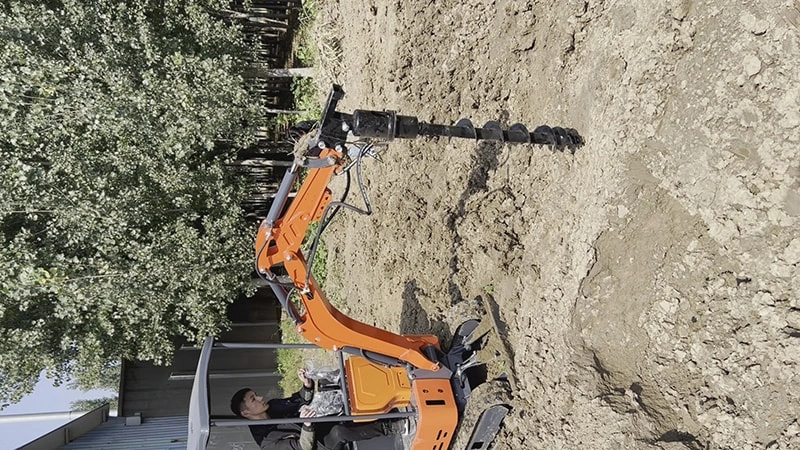
Mini Excavator with Auger Drill Attachment — Post Hole Digging in Garden
The Access Problem — Dimensions That Actually Determine Whether the Job Gets Done
Standard residential gate widths in Europe and North America range from 900 mm to 1,200 mm. The 06 series at 700 mm transport width fits through all of these with room to spare. The 10 series at 930 mm transport width fits through wider gates and most garden access points but requires some attention at narrower openings. The 12K at 930 mm and 1,000 kg fits the same envelope as the 10 series with a slightly higher digging force of 7.2 kN.
Beyond width, mini excavator landscaping access depends on height. The 06 series transports at 2,130 mm — it clears a standard 2.4-metre garage door with headroom to spare and can work under roof overhangs and pergola structures that would exclude larger machines. The 10 series at 2,190 mm and 12K at 2,200 mm are similar. These are not figures that most equipment hire catalogues publish prominently, but they are the numbers that determine whether the machine physically fits the site.
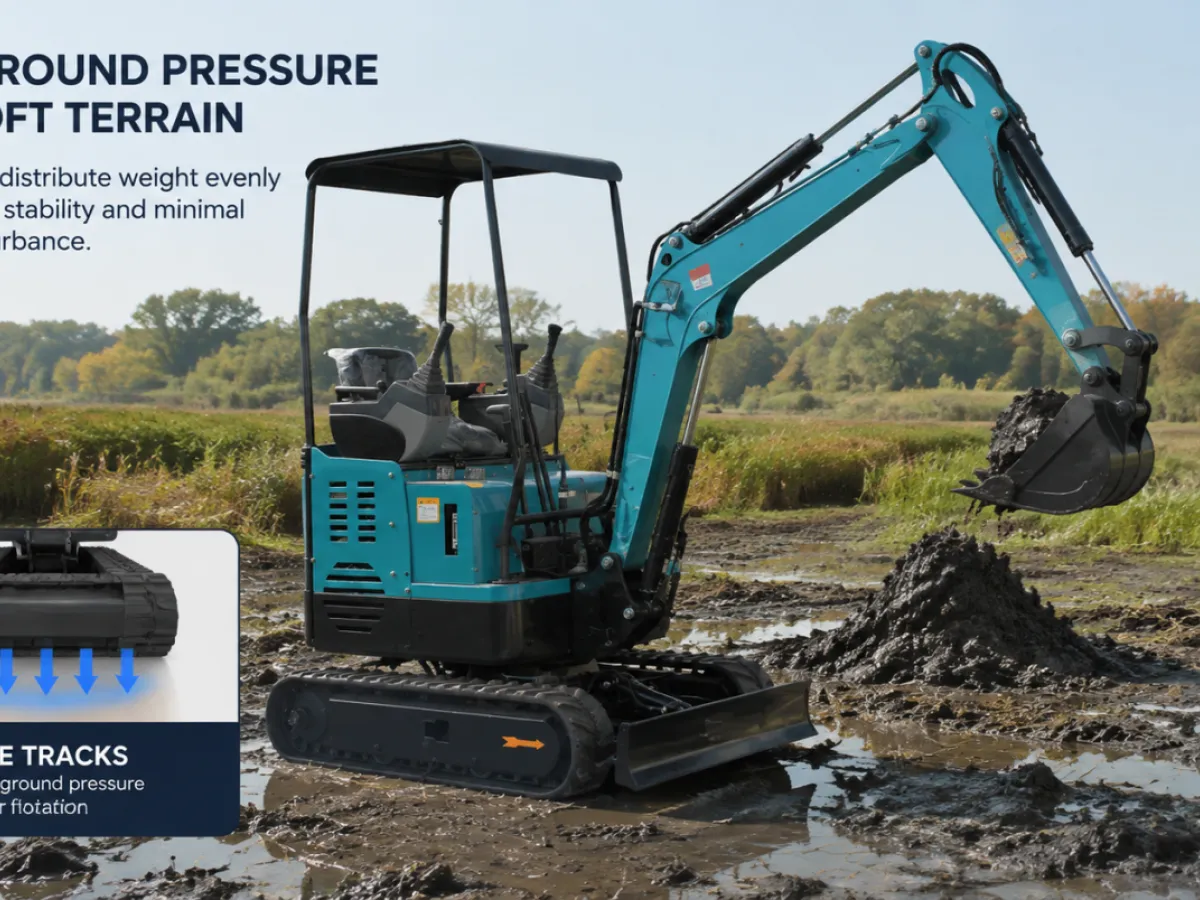
Weight is the third dimension of access, and it's most relevant for machines that need to cross timber decking, glass house floors, or recently compacted gravel paths. At 660 kg, the 06 series distributes its weight across the rubber track contact area to produce ground pressure comparable to a heavily loaded wheelbarrow on most surfaces. This is the machine for truly sensitive ground — the job where the client is watching the turf, not just the trench. The 10 series at 1,000 kg covers more serious digging work while remaining light enough for most residential applications.
Attachments That Define the Day's Work Profile
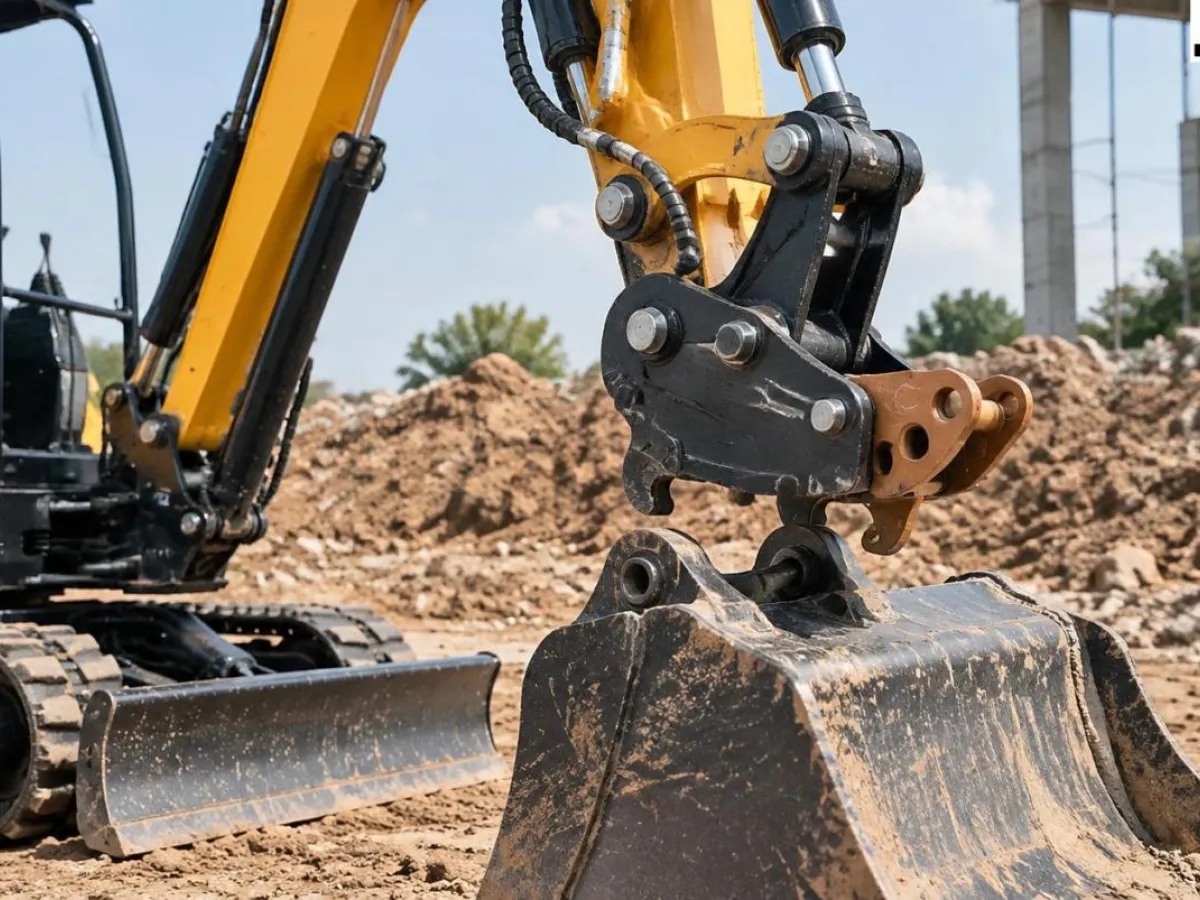
A mini excavator landscaping machine without the right attachments is half a solution. The attachment catalogue for the compact excavator range covers most of what a landscape contractor needs across a week's work: standard digging bucket (200 mm and 400 mm widths for trench and footing work), mud bucket for soft drainage material, auger drill for post holes and tree planting, rake for soil levelling and stone removal, and a flat bucket for grading work.
The rake attachment is particularly useful in landscaping because it handles the task that follows digging — pulling out stones and root material left in the topsoil layer — without requiring the operator to change to a different machine or work the area by hand. The rake is hydraulically operated, allowing the operator to work in reverse through broken ground and windrow the cleared material to the side of the trench or bed area. On jobs that involve soil preparation over large areas, the rake can process more ground in an hour than a crew working with hand tools can manage in a day.
The mud bucket — a wider, shallower bucket without serrated teeth — is the correct tool for drainage trench work in soft and wet ground. The standard digging bucket with teeth is efficient in compact soil but tends to create an irregular trench floor in wet clay, and the teeth can disturb the surrounding grade. The mud bucket's flat base cuts a clean trench profile and moves more material per pass in loose conditions. For garden drainage and French drain installation, it's the correct starting point rather than an upgrade.
The auger drill is available in multiple diameter configurations for different post-hole applications. Fence posts, pergola posts, deck supports, and planted trees all require different hole diameters — typically 150 mm to 400 mm. The auger is driven by the machine's hydraulic auxiliary circuit, and flow requirements should be matched to the auger motor's rated input. Under-flowing the auger causes stall in dense clay; over-flowing causes heat in the circuit. Article 56 covers auger selection and hydraulic matching in more detail.
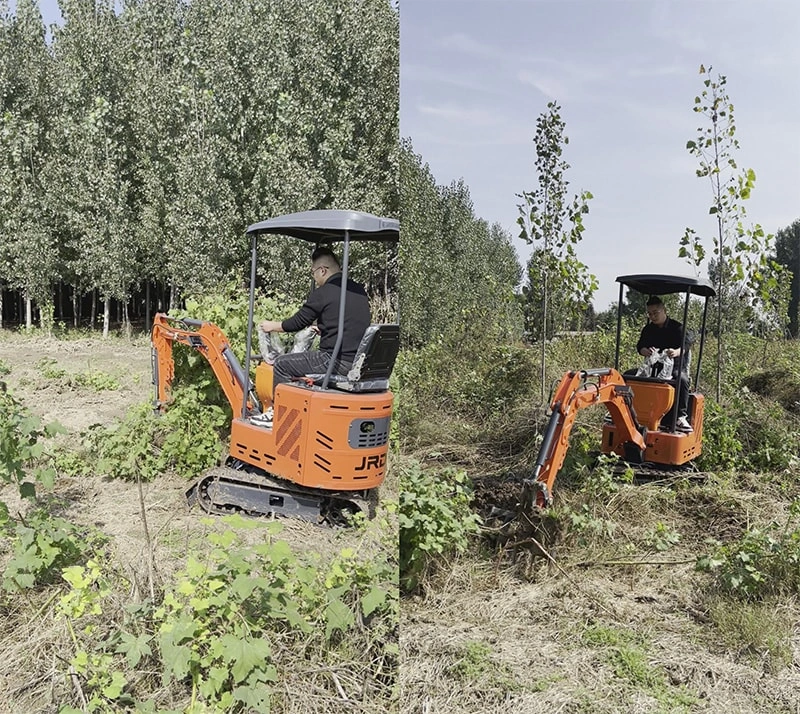
Mini Excavator with Rake Attachment — Soil Preparation in Garden Bed
Protecting Finished Surfaces — Turf, Paving, and Planted Areas
The most frequent complaint from residential clients about compact excavator work is surface damage — turf rutted by repeated passes, paving cracked by the tail swing of a machine turning in a tight area, planted beds disturbed by soil piled from a bucket that was loaded too full. These are operator technique issues as much as machine specification issues, but the machine choice sets the baseline.
On established turf, the rubber track's low ground pressure minimises visible track marks, but turning on the spot — what's called zero-radius turn or spin-turn — concentrates shear force on the turf and leaves a circular scar. Landscaping operators learn to execute three-point turns using combined travel and swing rather than spin-turns, and to avoid reversing on turf wherever the site layout permits forward-direction departure from the dig area. Placing plywood sheets under the tracks during sensitive surface work is a standard precaution on high-value residential sites.
Tail swing is determined by the counterweight position relative to the machine's centreline at maximum swing. On the 06 series, the machine's small size means the counterweight traces a relatively small arc. Checking that arc against the planted bed, pathway, or wall behind the machine before starting work is a two-second habit that avoids a two-hour repair conversation. For machines that spend most of their working time in tight residential spaces, the time spent on access planning — gate width, surface type, swing clearance behind — pays back immediately in avoided damage costs.
When the 06 Series Isn't Enough — Stepping Up Without Losing Access
There are mini excavator landscaping applications where the 06 series's 3.5 kN digging force and 1,091 mm maximum digging depth are not enough: removing large tree stumps with a ripper attachment, excavating footings in compacted fill, or digging through old concrete paths that weren't on the demolition drawings. The 10 series at 6 kN and 1,736 mm digging depth handles these tasks while still fitting through most residential access points at 930 mm track width.
The 12K at 7.2 kN and 1,650 mm depth, or the 13K at 11 kN and 1,740 mm depth, add further capability for more demanding landscaping conditions while maintaining the compact format that defines this machine category. The 13K also introduces the option for pilot control — the 13K Pro with hydraulic pilot handle — which makes fine grading and planting bed shaping significantly more precise than mechanical joystick control. On jobs where the output quality is the selling point of the contractor's service, the control precision of a pilot-equipped machine translates directly into presentation quality.
For buyers sourcing machines for landscaping contractor use: build the selection around access constraint first, then digging requirement. A machine that's 20% more powerful but 300 mm too wide for the access gate on the most frequent job type is less useful than the machine that fits every site reliably. Most landscape contractors find that a 10 series or 12K handles 80% of their work with the right attachment set, and a second, larger machine is brought in only for the heavy foundation or stump work that requires more force.
Sourcing compact excavators for residential landscaping or maintenance contractor use?
JRD Machinery offers CE-certified mini excavators from 660 kg, with full attachment catalogues including auger drills, rakes, tilting buckets, and mud buckets. Export documentation and CE certification available for all models.
Visit www.jrdmachinery.com to view models and attachments, or contact us with your access constraint dimensions and primary application for a specific model recommendation.