



Working Slopes and Embankments With a Mini Excavator — Technique, Limits, and Safety
Slopes are the most incident-prone environment for mini excavator operation. Most tip-overs do not happen on flat ground — they happen on embankments, sloped access tracks, and cut-face edges where the combination of machine weight, loaded bucket, and grade conspire against stability in ways that are not always obvious until the machine starts to move.
This article covers how to work safely and effectively on slopes and embankments with a compact excavator — the gradient limits, the positioning rules, the technique for cutting batters, and the machine configurations that perform best on hillside jobs.
Understanding the Stability Envelope on Slopes
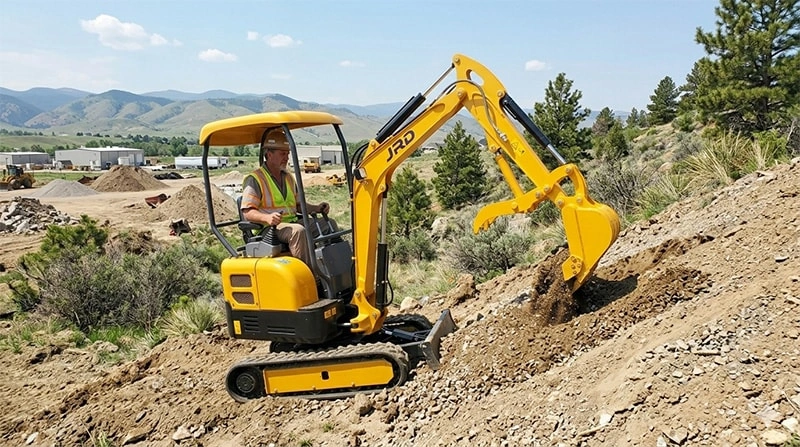
A mini excavator on flat ground has a stability envelope defined by its track width, wheelbase, and counterweight. On a slope, that envelope changes. The effective centre of gravity shifts uphill or downhill depending on machine orientation, and the moment required to tip the machine decreases as grade increases.
Most compact excavators are rated to operate on grades up to 30 degrees (approximately 58%) in the along-track direction — that is, with the machine facing up or down the slope, tracks parallel to the fall line. Across-slope operation is rated to substantially lower angles — typically 15–20 degrees maximum, and often less when the machine is loaded.
• Always position tracks parallel to the fall line — facing up-slope or down-slope, never across it
• Travel up and down slopes, not across them — if you must reposition across a slope, do so with the attachment lowered and the bucket empty
• Keep the loaded bucket close to the machine — at full reach on a slope, the combined moment of arm, bucket, and material can exceed stability limits
• Do not slew downhill with a loaded bucket — the lateral component of the load moves the centre of gravity toward the downhill track edge
Gradient Limits and What They Mean in Practice
A 30-degree along-track gradient is steeper than most road grades — a 1-in-2 slope. On loose or wet ground, traction fails before stability does, so the effective working limit is lower. Most experienced operators set a personal working limit of 20–25 degrees on formed surfaces and 15–18 degrees on loose or wet material.
For the 06 series and 10 series machines (sub-1,000 kg), the short wheelbase makes slope operation more sensitive to loading than larger machines. At these weights, the short track footprint means grade transitions — the point where a flat run meets a slope — create a sudden shift in the stability reference. Approach grade transitions slowly and with the attachment lowered.
The 16 series with telescopic undercarriage has an advantage on slopes: when tracks are extended to full width, the stability base increases significantly, lowering the effective tipping angle. For embankment work where the machine must traverse a cut face at angle, extended tracks improve the margin substantially.
For sustained slope work above 20 degrees — steep embankments, cutting through hillside for access tracks — machines in the 17 series to 22 series offer better stability than lighter classes, because the wider track gauge at these weights provides a broader base and the variable piston pump provides consistent hydraulic response on gradient without the pressure variations that can cause jerky control at steep angles.
Batter Cutting Technique
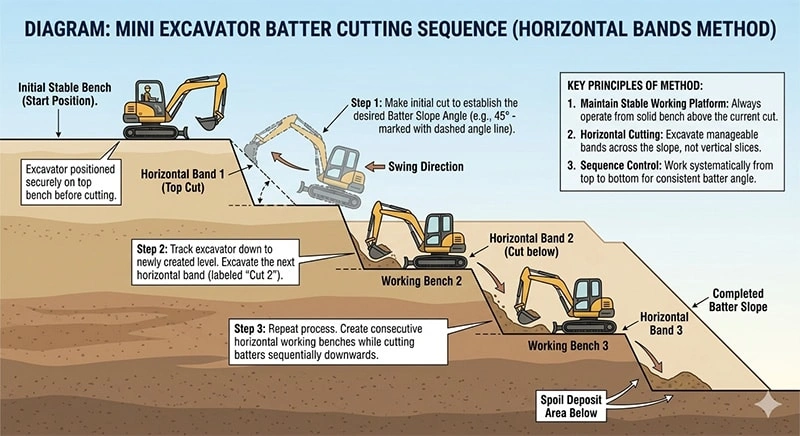
Cutting an embankment batter — the sloped face left after bulk excavation — is one of the most common slope tasks for a compact excavator. The technique depends on working from above the cut, not below it.
• Establish a bench: position the machine on flat or near-flat ground at the top of the intended cut face. The machine should never need to position on the batter itself — reach does the work
• Set the batter angle with the arm: angle the bucket tip to match the target batter slope (e.g., 1H:1V = 45 degrees). The bucket cutting edge follows this angle through the cut pass
• Work in horizontal bands: cut across the face in horizontal bands, starting at the top of the intended batter and working downward. This creates a consistent profile and prevents the face below from being undermined before the upper section is cut
• Finish with a cleanup pass: after the rough batter is cut, a final pass with a grading bucket dragged across the face smooths the surface and seals loose material
• Monitor water flow: cut faces on slopes intercept groundwater. If seeps appear during cutting, reduce the cut depth per pass and allow the face to drain before resuming
Slope Access — Getting the Machine to the Work
Many slope jobs start with the challenge of getting the machine onto the slope in the first place. A compact excavator on a 30-degree slope has a travel speed limit — most machines travel at reduced speed on steep grades to prevent runaway on descent. Use high-torque low-speed travel mode on any slope above 15 degrees.
• Ascend forward, descend backward (or descend in a controlled forward crawl with the bucket lowered as a brake) — do not descend steep grades with the machine facing downhill at speed
• Keep the heavy end uphill — the counterweight provides a stabilising moment; orient the machine so the counterweight is on the uphill side when traversing
• Avoid soft or wet ground on slope entries — a machine that loses traction on a slope can slide, and a sliding machine on a slope is uncontrollable
• Never step across a slope edge — the transition between cut face and natural ground is a tipping point; cross it slowly and with the arm folded
Working Near Slope Edges and Cut Faces
The most serious slope stability incident in excavator operation is not the machine on the slope — it is the machine working at the edge of an excavated slope or cut face that collapses. The ground at the edge of any excavated face carries tension cracks and reduced shear strength even when it looks solid.
• Maintain a minimum 1 m setback from any unsupported cut edge — more on cohesionless soils (sand, gravel, dry fill)
• Do not position the tracks parallel to an edge with one track closer than 500 mm to the break — if the edge gives, the track drops and the machine rolls
• Probe the edge if ground conditions are uncertain — push the bucket against the edge and observe whether the face yields before positioning the machine
• In wet conditions, assume any clay cut face has softened to below its dry strength and increase setback distances accordingly
Machine Configuration for Slope Work
For embankment and slope work, specify or confirm the following on the machine you select:
• Travel motor parking brake: should engage automatically when the travel joystick is released on a slope; a failing travel brake allows the machine to creep on grade
• Hydraulic line check valves: prevent the boom from dropping if a hose fails while the arm is extended on a slope; confirm these are present on the boom cylinders
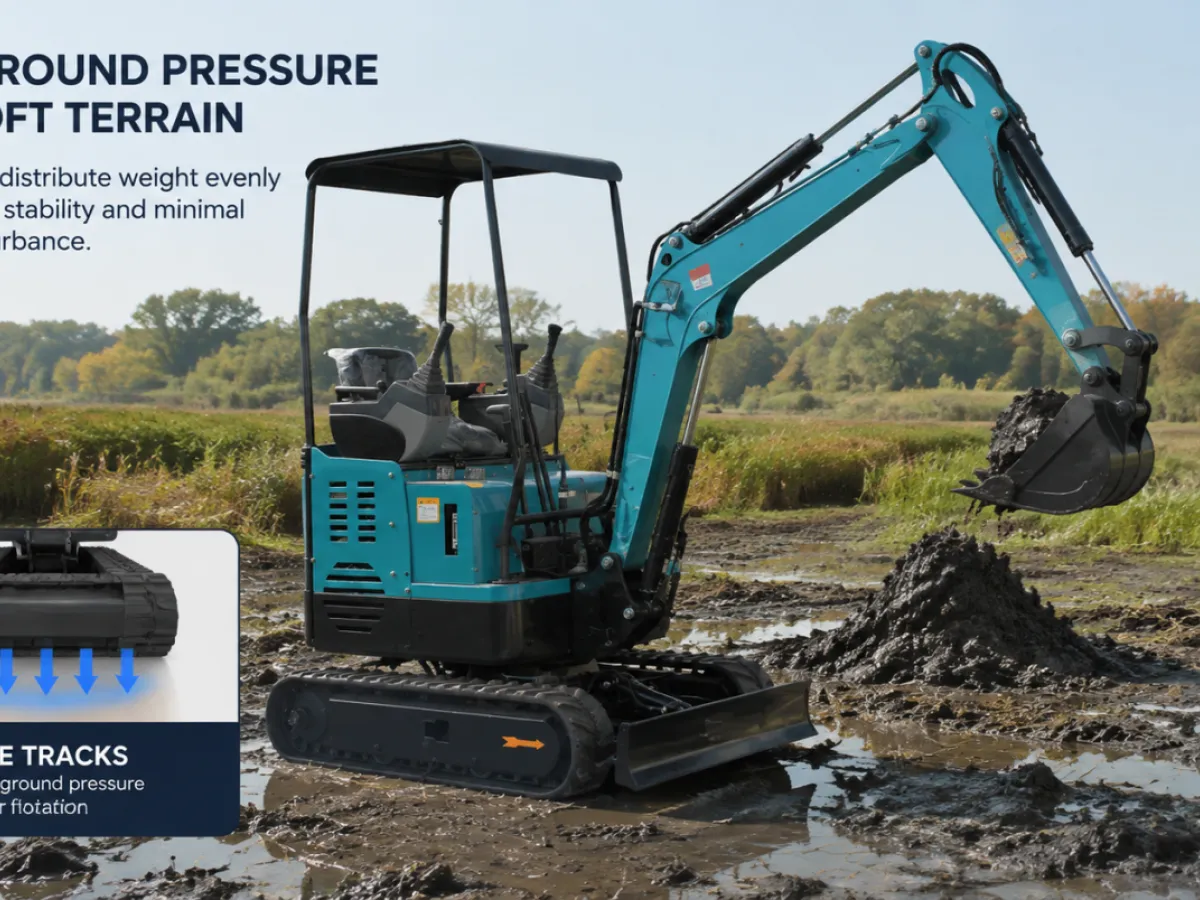
• Wide track option: if the machine class offers a wide-track version, use it for slope work — 50–100 mm of extra track width significantly shifts the tipping threshold
• ROPS compliance: on any slope work, the ROPS certification is not optional — it is the primary protection in a rollover event
Conclusion
Slope and embankment work with a mini excavator is achievable and productive when the operator understands the gradient limits, positions the machine correctly relative to the fall line, and uses batter-cutting technique from above rather than below the work face.
The machines best suited to sustained slope work are those with extended telescopic undercarriage for increased stability, variable piston pumps for consistent hydraulic response on grade, and certified ROPS/FOPS structures. Correct technique removes most of the risk — but correct machine selection and configuration eliminate the mechanical variables that technique alone cannot compensate for.
Working on slopes and embankments?
Contact JRD Machinery with your gradient requirements and site conditions. We can advise on track width options, telescopic undercarriage configurations, and stability specifications across the compact excavator range. CE-certified ROPS/FOPS documentation available for all models.