


GPS & Remote-Guided Operation of RC Slope Mowers
Introduction: The Technology Evolution
The first generation of remote-control slope mowers relied entirely on line-of-sight radio control — an operator watching the machine and managing it in real time with a handheld transmitter. While this approach remains the operational standard for most applications, the addition of GPS guidance systems, automated path planning, and telemetry integration is rapidly expanding what RC mowers can achieve in terms of accuracy, efficiency, and solo-operator productivity.
This article examines the GPS and guidance technologies now available on leading RC mower platforms, the operational contexts where they add most value, and the practical considerations for adoption.
GPS Guidance Technology Overview
|
Technology |
Accuracy |
Typical Application |
Cost Premium |
|
Standard GPS |
±2–5 m |
Geofencing only; no auto-guidance |
Low |
|
SBAS / EGNOS Corrected GPS |
±0.5–1.5 m |
Path logging, basic return-to-base |
Low–Medium |
|
RTK GPS (Network or Base Station) |
±10–20 mm |
Autonomous strip mowing, precision repeat passes |
High |
|
RTK + IMU Fusion |
±10 mm + slope-compensated heading |
Steep slope autonomous operation |
Very High |
|
Visual SLAM (Camera-based) |
±50–100 mm (local) |
Obstacle detection, panel frame avoidance |
Medium–High |
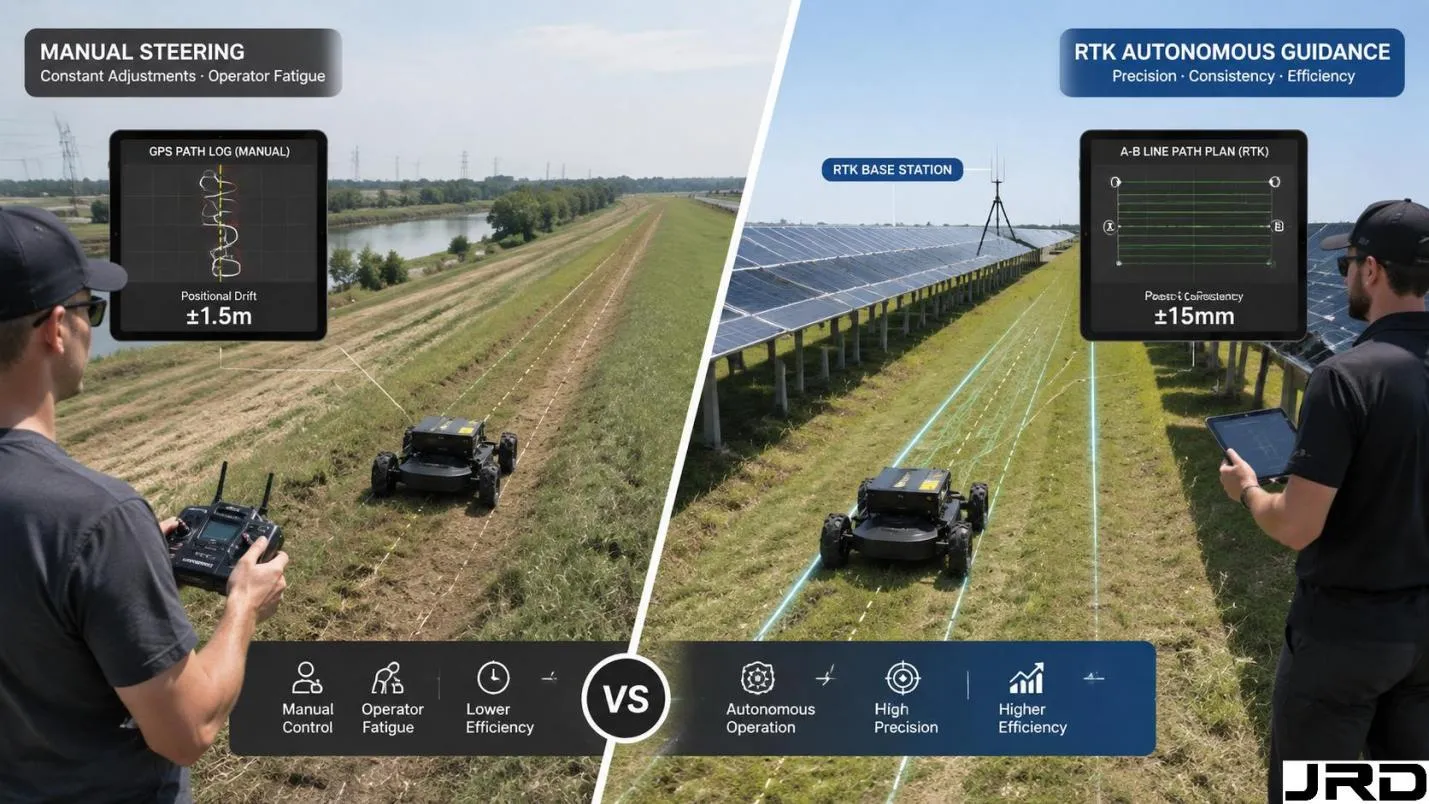
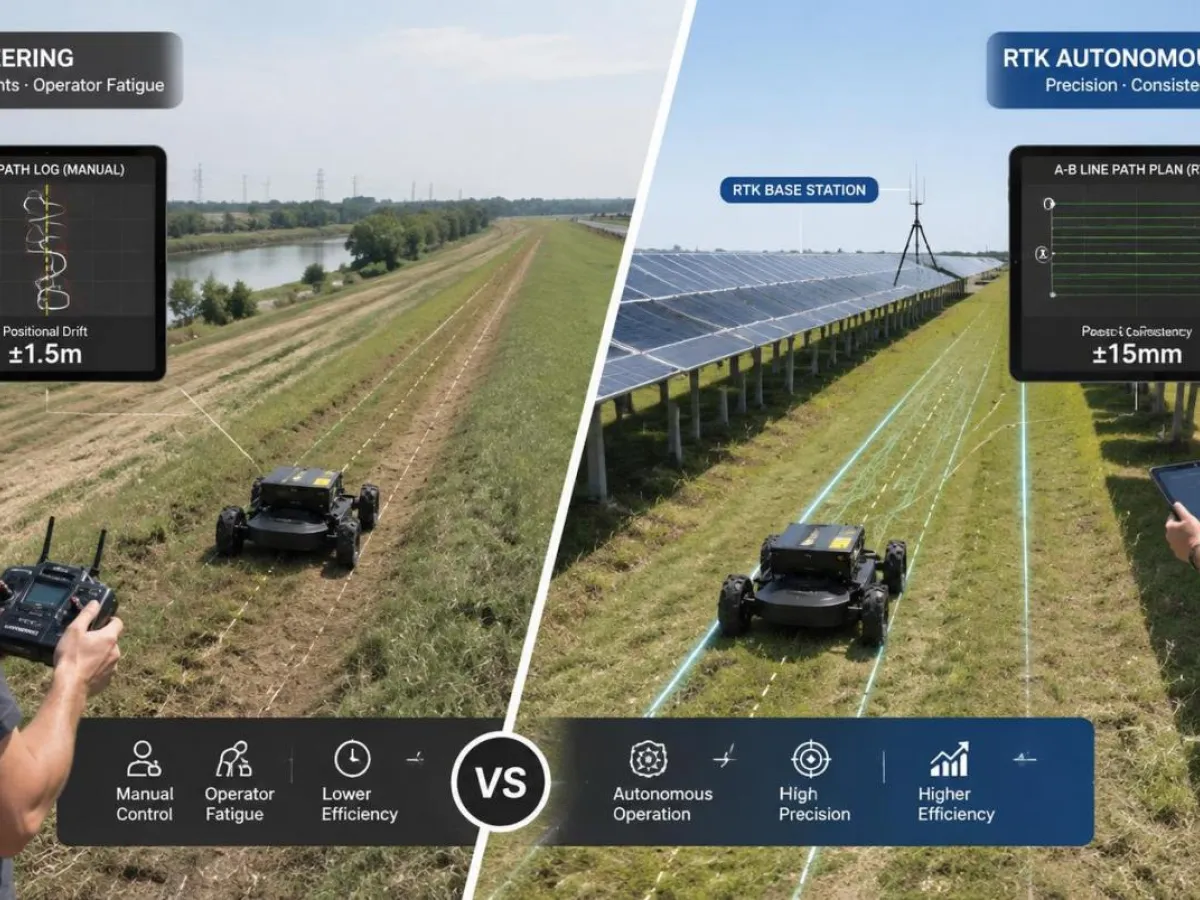
RC mower manual steering vs RTK GPS autonomous strip mowing comparison
For most vegetation management applications, SBAS-corrected GPS provides sufficient accuracy for geofencing and path logging without the infrastructure cost of RTK base stations. Truly autonomous strip mowing — where the machine follows the same line on repeat visits — requires RTK accuracy.
Geofencing: Defining the Safe Operating Area
What Geofencing Does
A geofence is a GPS-defined boundary uploaded to the mower's onboard controller. When the machine approaches the boundary, it triggers an automatic slowdown and stop. If the operator's radio signal is lost and the machine continues to move, the geofence provides a final safety backstop, preventing the mower from leaving the defined work area and entering a road, watercourse, or other hazard.
Setting Up a Geofence
Walk the boundary of the intended work area with a GPS data logger or tablet app
Upload the polygon boundary to the mower's control system via Bluetooth or USB
Set the geofence inset margin (typically 0.5–1.0 m inside the true boundary to allow for GPS positional error)
Test geofence stop response before commencing work
Update the geofence boundary whenever the work zone changes
Note: Geofencing is a safety redundancy layer, not a substitute for operator supervision. Current regulations in all major markets (UK, EU, US) require a qualified operator to maintain visual contact with an RC mower at all times during operation.
RTK GPS Path Guidance: Autonomous Strip Mowing
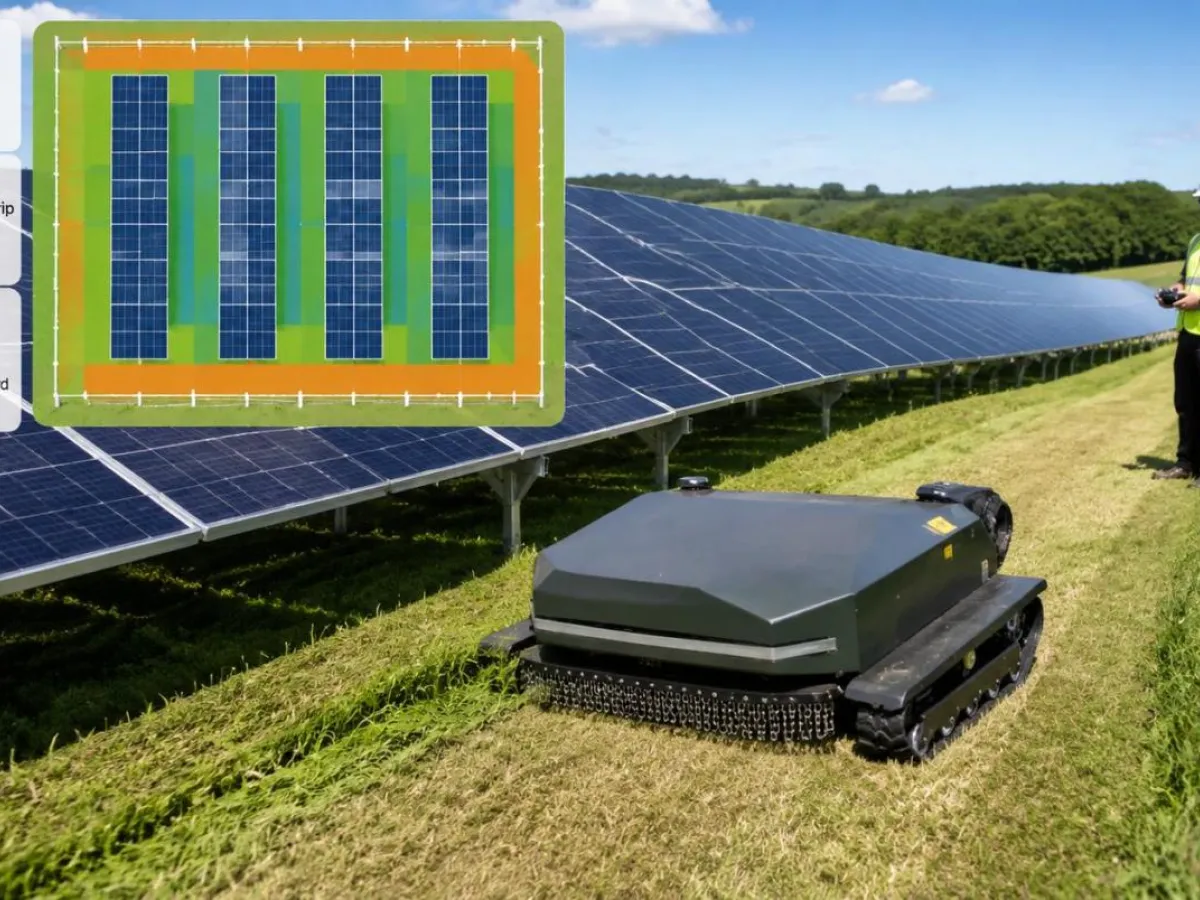
RTK GPS guidance allows an RC mower to follow a pre-planned path autonomously, with the operator supervising rather than actively steering. The operator defines A-B lines or headland boundaries using the field computer, and the machine executes parallel strip passes with pass-to-pass consistency of ±15 mm.
Benefits of RTK Path Guidance
Eliminates operator steering fatigue on long, repetitive embankment strip passes
Provides consistent overlap between passes (typically 100 mm), preventing missed strips
Enables one operator to supervise multiple machines simultaneously (where regulations permit)
Records as-worked GPS tracks for proof of coverage in contract documentation
Reduces fuel consumption by 8–12% compared to manual steering through more efficient path geometry
Current Limitations
RTK requires a base station or subscription to an RTK network correction service (e.g., Trimble VRS, Leica SmartNet)
Signal occlusion from tree canopy or bridge structures can cause brief loss of RTK fix
Steep slopes require IMU integration to maintain heading accuracy as pitch/roll changes
Headland turns at row ends still typically require manual operator guidance
Telemetry & Fleet Management
Modern RC mower platforms increasingly offer cellular telemetry modules that transmit real-time machine data to a cloud-based fleet management portal. This enables contractor operations managers and asset owners to monitor machine status without being physically present at the work site.
|
Telemetry Data Point |
Operational Use |
|
GPS Position (live) |
Verify machine is within contracted work zone |
|
Engine Hours |
Plan scheduled maintenance intervals remotely |
|
Fuel Level |
Predict refuelling requirements for job costing |
|
Blade Engagement Status |
Confirm productive cutting time vs. transit time |
|
Error Codes / Fault Flags |
Alert maintenance team before breakdown occurs |
|
Cut Area (ha, calculated) |
Generate automated production reports for client invoicing |
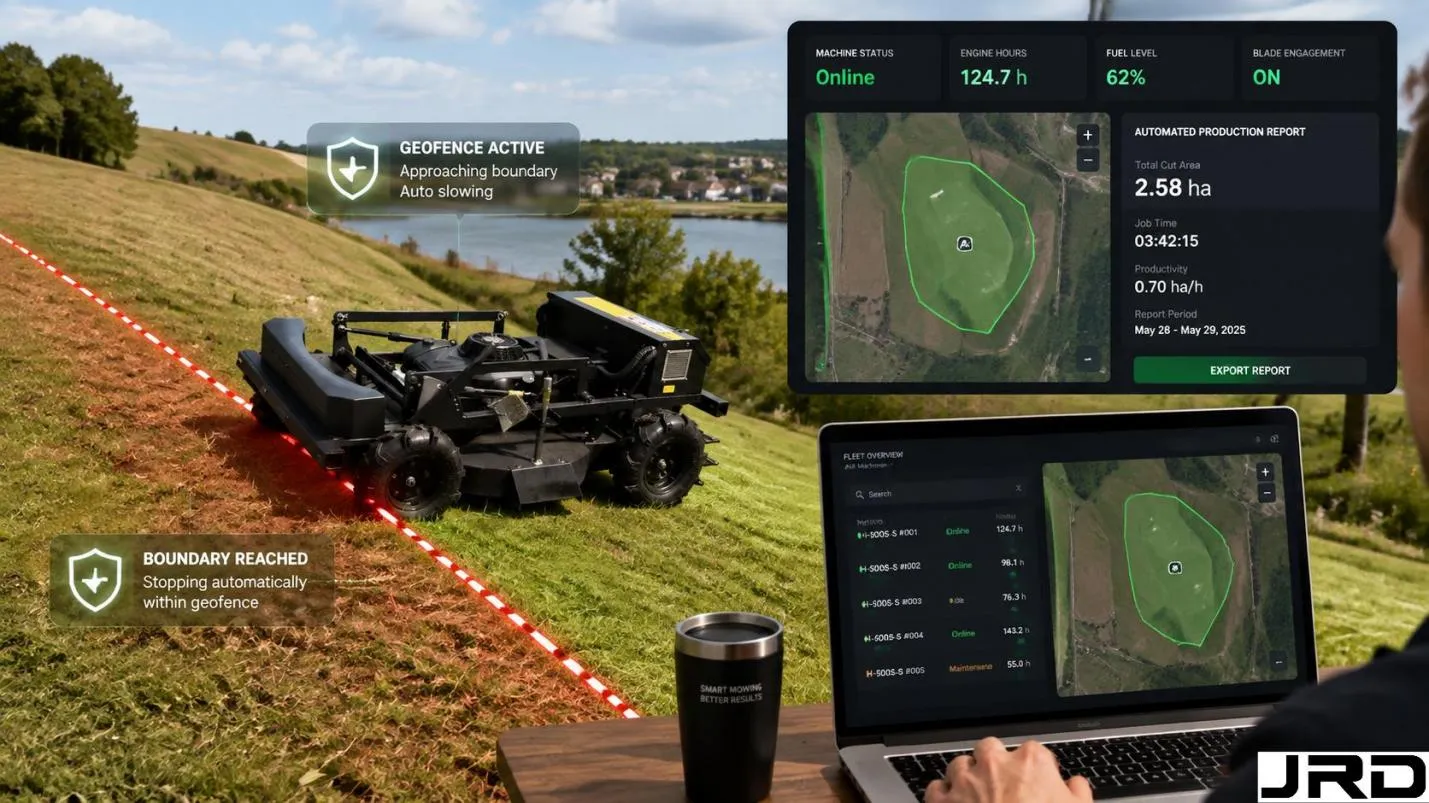
RC mower GPS geofencing safety and telemetry fleet management dashboard
Regulatory Context for Autonomous & Semi-Autonomous Mowers
No current major market (UK, EU, US) permits truly unattended autonomous operation of RC mowers in public spaces or alongside live traffic. The emerging regulatory framework from bodies including the UK Health and Safety Executive (HSE) and EU Machinery Regulation 2023/1230 requires a trained operator to maintain supervisory oversight at all times.
However, the definition of 'supervisory oversight' is evolving. Some interpretations permit the operator to supervise via on-screen video feed rather than direct line of sight, provided the video system has sufficient resolution and latency to enable prompt emergency intervention. Operators considering any form of beyond-line-of-sight (BLOS) operation should obtain a specific risk assessment and legal review before deployment.
Summary: Adopting GPS-Guided RC Mowing
Start with geofencing as the first GPS technology addition — significant safety benefit at low cost
Evaluate RTK guidance where long parallel strip mowing (embankments, solar farms, sports fields) forms a significant proportion of the work programme
Integrate telemetry with existing fleet management software to streamline maintenance scheduling and client reporting
Engage legal and H&S advisors before implementing any supervisory model beyond direct line of sight
Monitor HSE and Machinery Regulation guidance updates — the autonomous mowing regulatory framework is expected to evolve significantly before 2030
Specifying GPS-guided RC mowers for a large or linear site? JRD Machinery is an RC slope mower manufacturer and supplier, and can configure machines with RTK path guidance, geofencing, and telemetry integration. We advise on base station options, correction service subscriptions, and fleet portal setup. Contact us to discuss the level of guidance automation that suits your work programme.
Get in touch for expert advice or a quote:
Email:info@jrdmachinery.com
Website: www.jrdmachinery.com