


RC Mower Rental vs Purchase Finding the Crossover Point
Introduction: Not Every RC Mower Needs to Be Owned
The assumption that the best way to access an RC slope mower is to purchase one outright is worth examining carefully. The commercial grounds maintenance market offers three distinct routes to RC mower access — outright purchase, contract hire/operating lease, and short-term rental — and each serves a different operational and financial profile. For some operators, ownership is clearly the right answer. For others, rental provides a more flexible and financially efficient path. A significant number find that a hybrid approach — owning a base fleet and supplementing with rental for peak demand — is optimal.
This guide walks through the decision framework: the key variables that determine which route is right for your operation, a cost comparison methodology, the practical considerations of each route, and the scenarios where each option clearly wins.
The Three Routes to RC Mower Access
Before comparing costs, understand what each route actually provides:
Outright purchase: You own the machine. Full capital cost upfront (or via hire purchase finance). You bear all maintenance, insurance, and depreciation costs. You control deployment, modifications, and disposal. Best for operators with consistent, high utilisation requirements.
Contract hire / operating lease: A finance arrangement where you pay a fixed monthly amount to use the machine for an agreed term (typically 36–60 months) and return it at the end. Maintenance is often included in the contract. Off-balance-sheet treatment may be available depending on lease structure. Best for operators who want predictable costs without end-of-life disposal risk.
Short-term rental: Hire a machine from a plant hire company for days, weeks, or months as needed. You pay only for the time you use the machine. No capital commitment, no long-term obligation, no maintenance responsibility. Best for occasional or seasonal requirements, or for trialling before committing to purchase.
The Utilisation Threshold: The Core Decision Variable
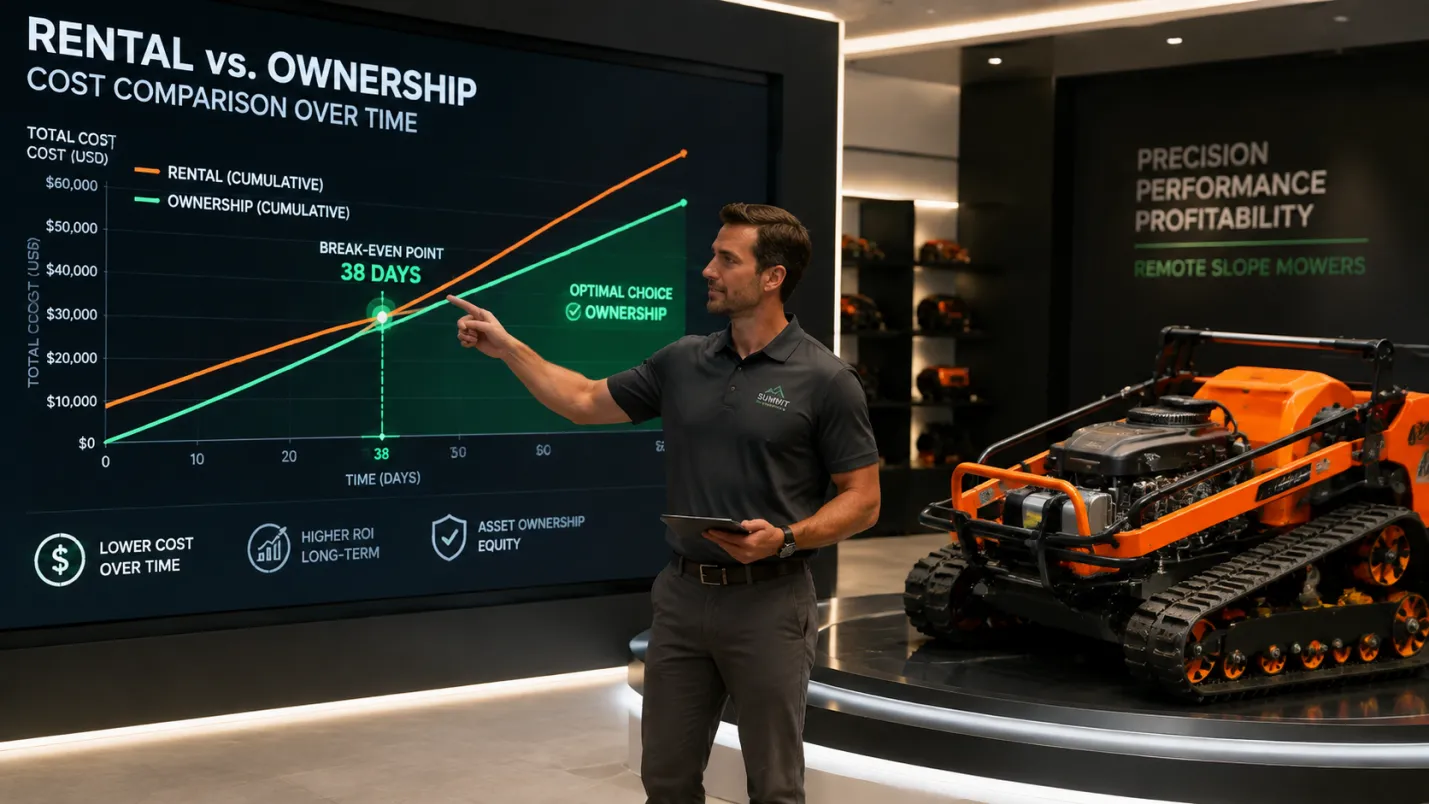
The most important number in the rental-vs-purchase calculation is your anticipated utilisation — the number of days per year you will actually use an RC mower. This threshold determines the financial crossover point:
Ownership total annual cost (indicative, mid-range RC mower at £55,000): Capital repayment at 5-year straight-line depreciation = £11,000/year; maintenance and consumables = £3,500/year; insurance = £1,200/year; storage = £600/year. Total: approximately £16,300/year.
Daily rental rate (indicative, mid-range RC mower from plant hire company): £350–£500/day including delivery within 50km.
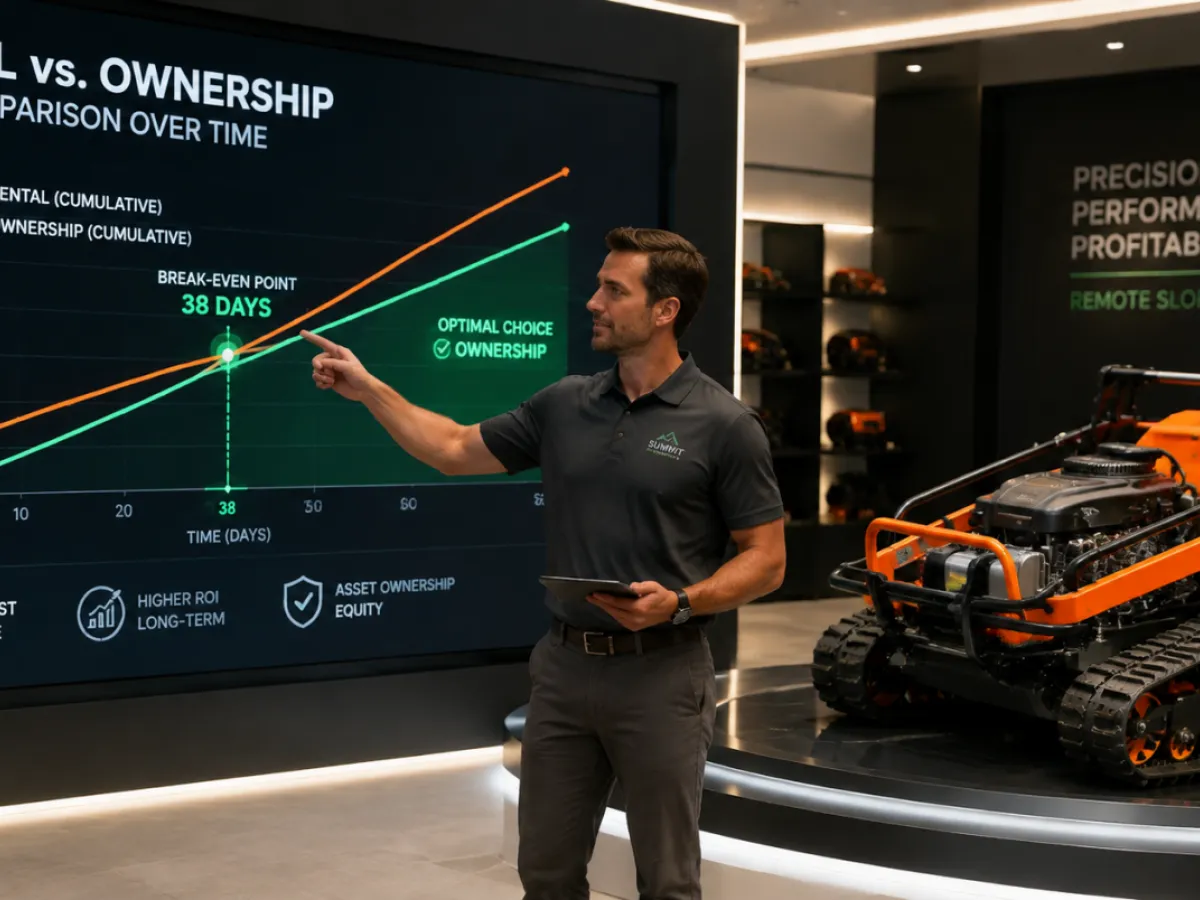
Crossover calculation: £16,300 ÷ £425/day average rental = approximately 38 days. If you use an RC mower for fewer than 38 days per year, rental is cheaper than ownership on a pure cost basis. Above 38 days, ownership begins to generate a cost advantage.
This is a simplified model — it does not account for financing cost, operator training, or the option value of machine availability. But it provides a useful starting benchmark. Operators with seasonal or project-based requirements well below this threshold should lean toward rental; those with year-round consistent requirements well above it should lean toward purchase.
When Rental Is the Right Choice
New market entry: You have won a contract that requires slope mowing capability you do not currently own. Rental lets you fulfil the contract and assess actual machine utilisation before committing to purchase.
Seasonal peak demand: Your base fleet handles typical weekly requirements, but spring growth season creates a 6–8 week peak period where you need additional capacity. Rental supplements owned capacity for peak periods without idle machine costs in winter.
Trial before purchase: Rental of a specific model for 2–4 weeks on your actual sites, with your operators, on your terrain, provides far better purchase decision information than a manufacturer demonstration. Most RC mower hire companies will apply hire cost against purchase price if you proceed within a defined period.
Project-based requirements: A one-off land clearing project, a post-flood embankment restoration contract, or a seasonal ski resort preparation assignment may create a defined-duration need that does not justify capital purchase.
Machine-down cover: Your owned machine is in for a major repair. A rental machine keeps your contracts running without penalty delays.
When Purchase Is the Right Choice
High and consistent utilisation: Your operational pipeline clearly supports 50+ days per year of RC mower use for the foreseeable future. Ownership cost per day is materially lower than rental above this threshold.
Specialist specification: Your terrain requires a specific machine configuration — slope rating, attachment type, deck specification — that is not available in local plant hire inventory. Ownership ensures you have the right machine available when you need it.
Branding and client relationship: Some commercial grounds maintenance clients prefer or require that contractors operate their own equipment rather than hire plant. Owned machines with your livery and documented service history support client confidence.
Operator training investment: Building operator competence on RC mowers is a meaningful investment in training time. With owned equipment, that competence is retained and continuously refined. With rental machines, operators work with unfamiliar machines each time, which affects both productivity and safety.
Long-term contract security: A 3–5 year grounds maintenance contract with a defined slope mowing requirement provides a foundation for a purchase decision that eliminates the utilisation threshold uncertainty.
Contract Hire and Operating Lease: The Middle Ground
For operators who want the operational certainty of a dedicated machine without the capital outlay or end-of-life risk of ownership, contract hire offers a viable middle path:
Fixed monthly cost: Typically covers depreciation, maintenance, and sometimes insurance within a single predictable payment. Simplifies budgeting and cash flow management.
Technology refresh: At the end of the lease term, you return the machine and lease a new model — keeping your fleet at current technology without managing used asset disposal.
Maintenance inclusion: Leases that include a full maintenance package remove the risk of unexpected major repair costs during the lease period.
End-of-term options: Most contracts offer purchase at residual value, return, or roll into a new agreement. Evaluate these options carefully at lease inception — the residual value assumption significantly affects the total cost comparison.
The main limitation of contract hire is commitment — you are locked into payments for the lease term regardless of whether utilisation changes. If a contract is lost mid-term, the hire payments continue. Ensure your contract pipeline justifies the lease commitment before signing.
Practical Rental Considerations: What to Confirm Before Hiring
Machine specification match: Confirm the hire machine's slope rating, deck type, and hydraulic attachment compatibility match your site requirements. Not all hire fleet machines are configured for extreme-gradient work.
Delivery and collection logistics: Confirm lead time, delivery area coverage, and any additional transport costs for your site locations.
Operator training: Confirm whether the hire agreement includes a familiarisation session with the specific machine. Operating an unfamiliar RC mower model on steep terrain without any familiarisation is a safety risk.
Damage liability: Review the hire agreement's damage excess and the process for reporting machine incidents. RC mowers are complex machines — understand your liability exposure before deployment.
Fuel and consumables: Clarify whether the machine is supplied full of fuel and whether refuelling cost is included in the hire rate or charged additionally.
Hybrid Fleet Strategy: Owned Base + Rental Surge Capacity
The optimal commercial approach for many medium-to-large grounds maintenance operators is a hybrid model: own the minimum fleet size justified by your consistent year-round utilisation, and supplement with rental during peak demand periods. This approach:
Minimises idle machine cost in low-demand periods by keeping the owned fleet small.
Provides unlimited capacity for peak periods without the permanent capital cost of that capacity.
Reduces risk from contract loss — a smaller owned fleet is easier to manage if work volumes fall.
Allows technology trial through rental exposure before making owned fleet specification decisions.
Contact Us
Working out whether to buy or hire an RC slope mower? JRD Machinery is an RC slope mower manufacturer and supplier, so we can quote outright purchase and contract hire terms against the same machine specification — which makes your crossover calculation straightforward. Demonstration units are available for operators who want to trial a machine on their own terrain first. Contact us with your annual utilisation estimate.
Get in touch for expert advice or a quote:
Email:info@jrdmachinery.com
Website: www.jrdmachinery.com