


Pipeline and Utility Corridor Vegetation Management with RC Mowers
Introduction: The Kilometres Nobody Sees But Everyone Depends On
The UK's energy and utility infrastructure depends on thousands of kilometres of buried pipelines and overhead transmission lines that traverse agricultural land, moorland, woodland, and urban fringes. Maintaining the vegetation on these corridors is not optional — it is a regulatory, safety, and operational requirement. Inspection strips above buried pipelines must be kept clear of dense vegetation so that pipeline inspection teams can walk the route and identify ground movement, erosion, and surface indicators of subsurface issues. Overhead line wayleave corridors must be managed to prevent tree and shrub encroachment that could cause line contact and outage events. Compressor station surrounds and pressure reduction installations require tidy perimeter vegetation management for security and operational access. Keeping the vegetation on those corridors under control is now routine work for RC slope mowers, and for the utility contractors who run them.
These corridor environments present a consistent challenge: they often traverse sloping terrain — pipeline routes frequently follow contours across hillsides, and transmission line corridors cross ridges and valley sides — and they extend for kilometres in a linear pattern that makes conventional mowing very slow and labour-intensive. Remote-controlled slope mowers, particularly when deployed from a support vehicle along the corridor route, provide a dramatically more efficient and safer way to maintain these critical infrastructure margins.
Why Utility Corridors Are Ideal RC Mower Territory
Utility corridors combine several characteristics that specifically favour RC mower deployment over conventional methods:
Linear structure: A pipeline or transmission line corridor extends in a single linear direction. RC mowers working a linear corridor can be set in a consistent travel direction and managed efficiently by a single operator walking alongside on the corridor access route.
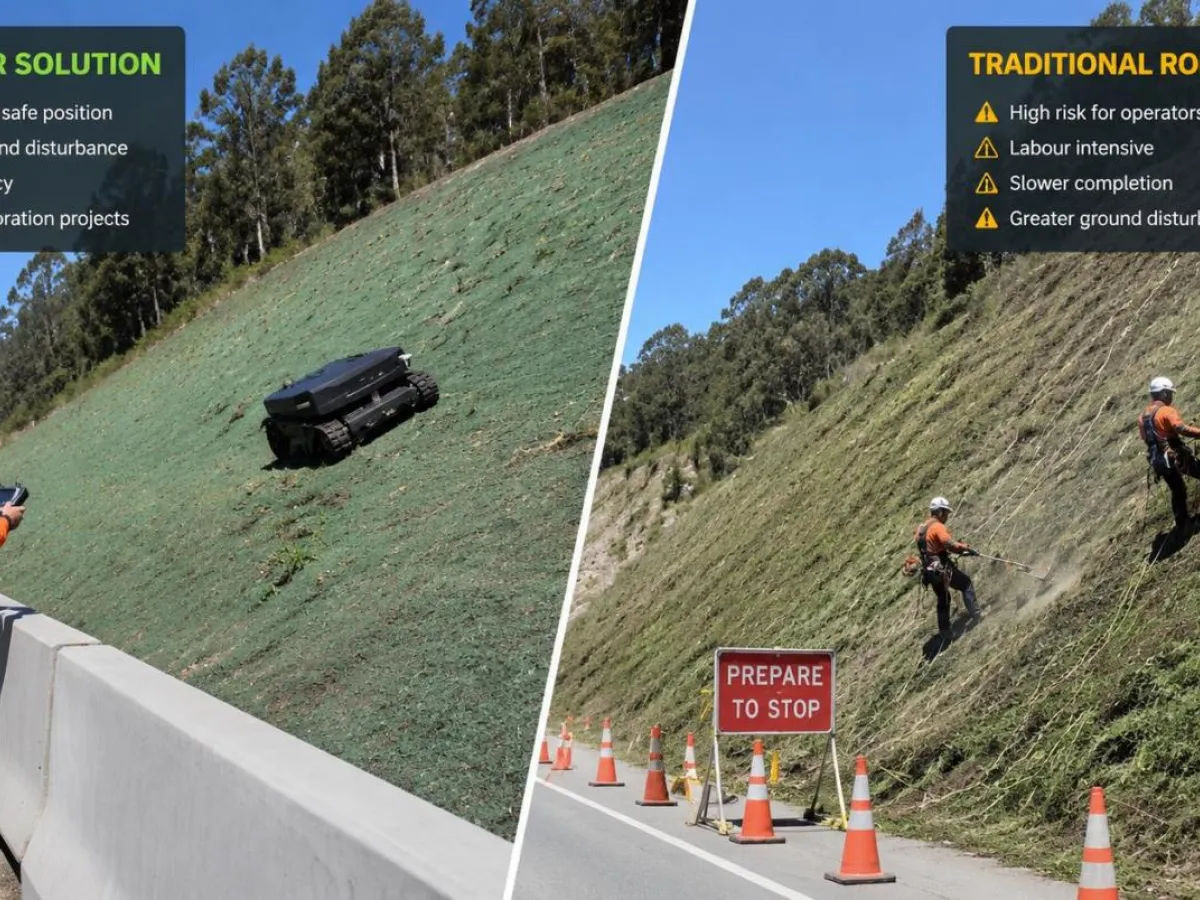
Sloping cross-section: Pipeline and transmission line routes often cross hillsides at an angle, creating an embankment cut-and-fill profile. The uphill cut face and downhill fill face are classic RC mower terrain — steep, uniform, and directly adjacent to a flat access track.
Remote locations: Many utility corridors traverse farmland, moorland, or woodland far from population centres. Walk-behind operators on remote multi-kilometre routes have significant welfare and fatigue management implications. RC mowers extend effective working range and reduce the physical burden of corridor maintenance.
Inspection frequency requirements: Pipeline operators are typically required to inspect their infrastructure at defined intervals — annually or more frequently on high-pressure transmission lines. The mowing cycle is often coordinated with the inspection walk, meaning the mowing team and the inspection team work in coordination along the route.
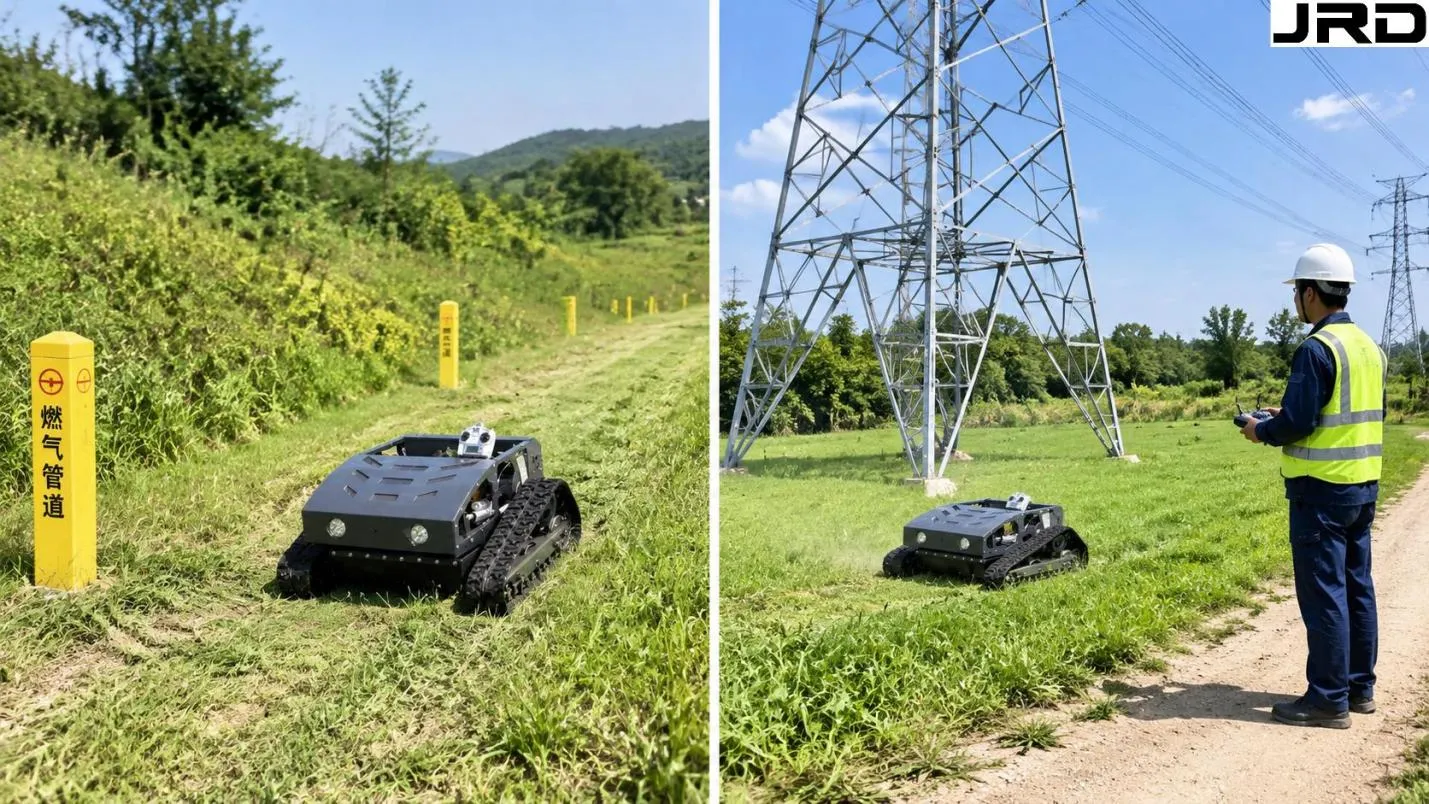
Safety benefit: Gas pipeline and electrical infrastructure corridors carry significant personal safety risk for anyone working adjacent to or above the asset. RC mowers keep operators at a distance from buried assets and high-voltage overhead lines.
Gas Pipeline Corridor Management
High-pressure gas transmission pipelines operated by National Gas (formerly National Grid Gas Transmission) and regional distribution networks require specific vegetation management on the above-ground pipeline corridor strip:
Inspection strip width: Typically 3–6 metres centred on the pipeline alignment, maintained as short grass (under 300 mm) to allow walking inspection and visual monitoring of the ground surface.
Root restriction zone: Trees and woody scrub are prohibited within a defined distance of the pipeline (typically 3 metres for high-pressure transmission lines) to prevent root damage to pipe coating. RC mowers help maintain the grass-only condition that prevents scrub establishment.
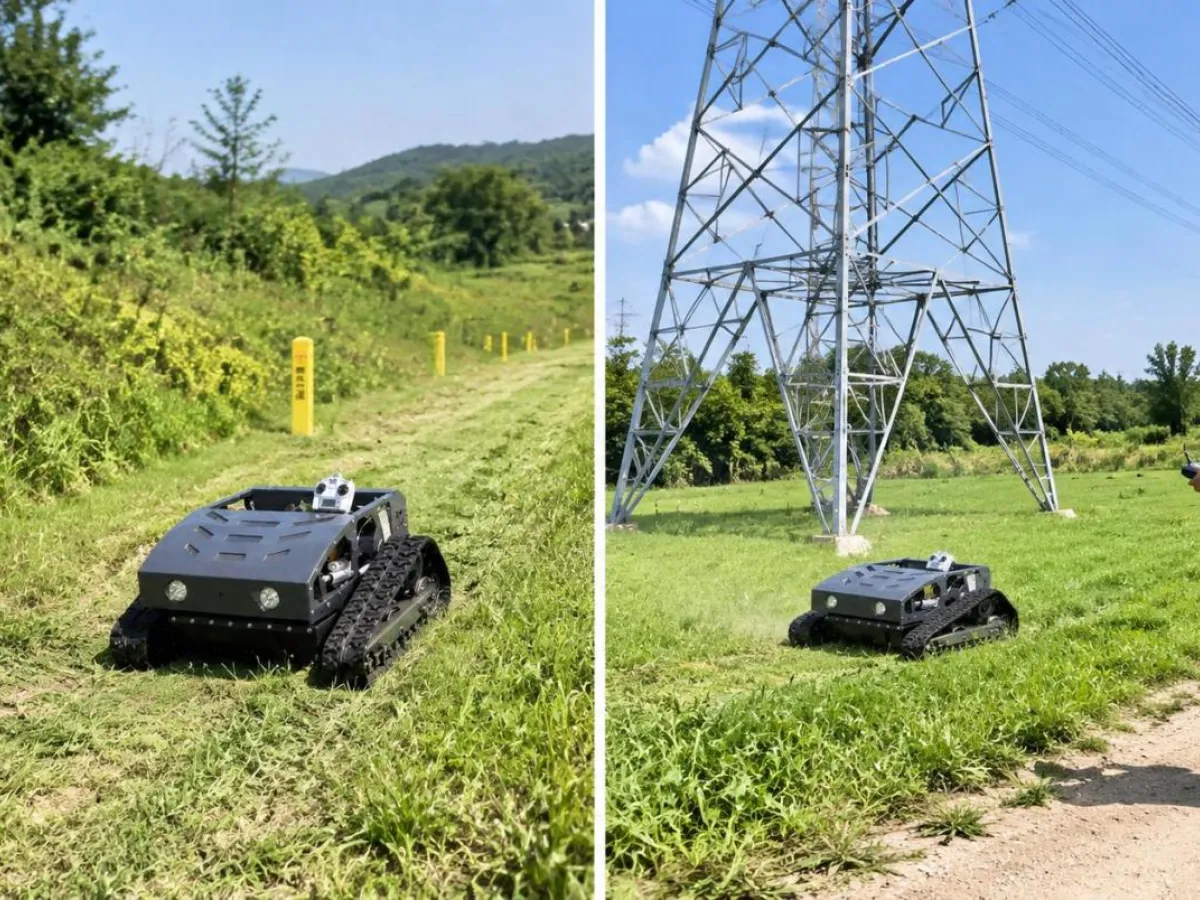
Marker post clearance: Pipeline marker posts appear at regular intervals on the corridor. Operators must maintain clear visibility of all marker posts — mowing around and clearly exposing each post is an operational requirement, not a cosmetic preference.
No ground disturbance: RC mowers must be configured to avoid blade contact with the ground surface above the pipeline alignment. Deck height set to minimum 75 mm above the corridor surface prevents any risk of deck or blade contact with the shallow soil above a buried pipeline.
Emergency response access: The corridor must remain clear enough to allow emergency response vehicle access along the inspection track at all times. RC mowing operations must not block the access track and must be suspended if emergency vehicles require corridor access.
Overhead Transmission Line Wayleave Corridors
The wayleave strips flanking overhead electricity transmission and distribution lines are managed to prevent tree and shrub growth that could cause line contact. The structure of these corridors differs from pipeline strips:
Wider corridor widths: Transmission line wayleaves are typically 30–60 metres wide (wider than pipeline strips) to provide an adequate clearance zone. RC mowers working these corridors address the central grass strip and the sloping sides of the access track rather than the full wayleave width.
Statutory public safety requirement: DNOs (Distribution Network Operators) and transmission operators have statutory obligations under the Electricity Act 1989 to maintain vegetation clearance from conductors. Inadequate vegetation management that leads to a line contact event carries legal and regulatory consequences.
Proximity to live conductors: Operations below or adjacent to overhead lines require specific safe system of work documentation. The approach distance to live conductors must be maintained for all equipment — confirm the overhead line voltage and the minimum approach distance before any RC mower deployment under or near overhead lines.
Pylon foundation surrounds: The steel lattice pylon foundations that support transmission lines are often on slightly raised ground pads surrounded by grass. These areas require regular cutting to maintain access for inspection teams and to prevent vegetation accumulation that could trap moisture against the steelwork base.
Operational Planning for Linear Corridor Mowing
Utility corridor mowing requires a different operational approach to area mowing:
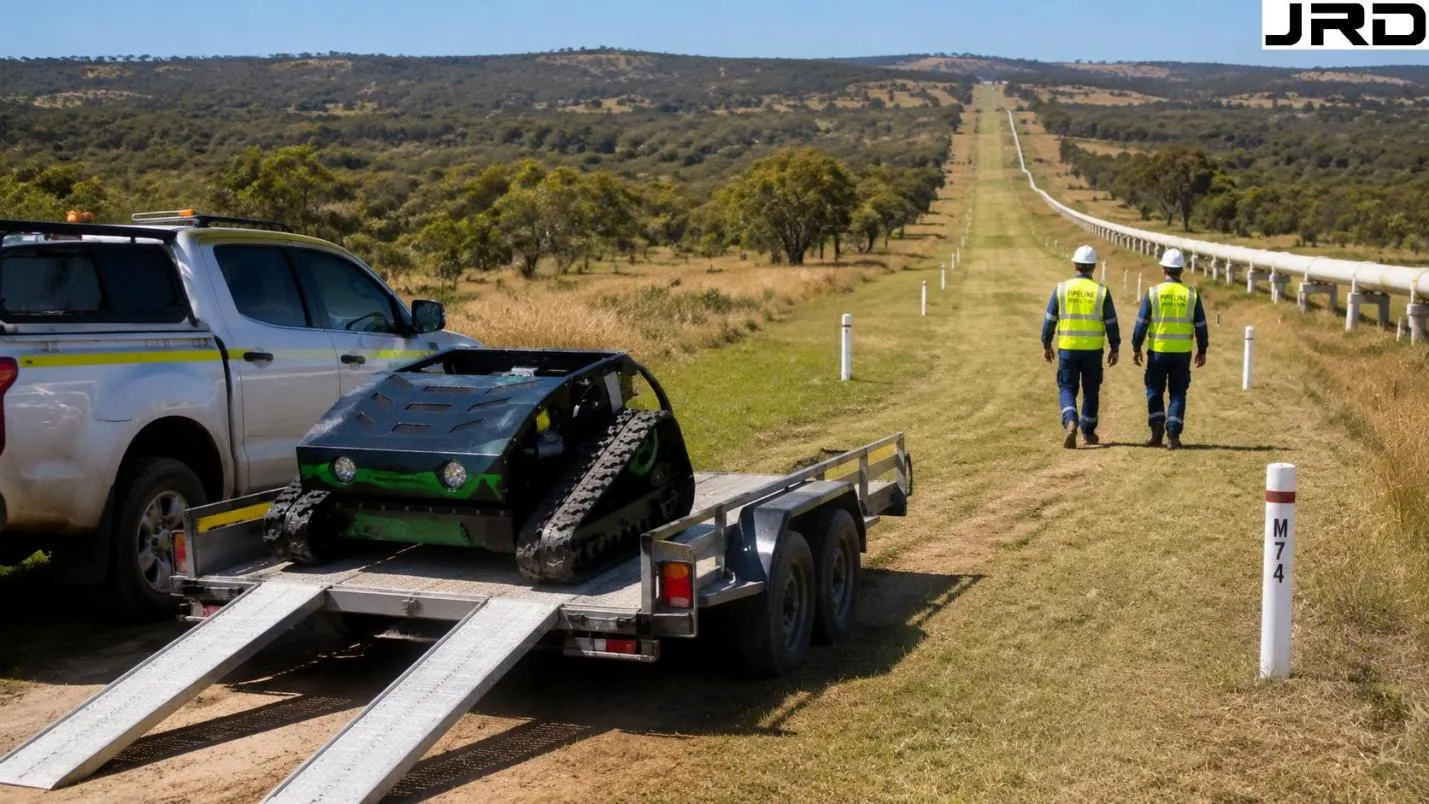
Vehicle-supported deployment: For multi-kilometre corridor runs, the RC mower is transported on a trailer or low loader along the access track, offloaded to work a section, reloaded, and moved to the next accessible section. Confirm the support vehicle's ability to access the corridor at all access points before the mowing season.
Section-based planning: Divide the corridor into manageable sections based on access points and typical slope changes. Each section is mowed as a complete unit before moving to the next.
Landowner access coordination: Utility corridors cross multiple land ownerships. Confirm access rights with each landowner (typically via the pipeline or line operator's wayleave rights) before scheduling operations to avoid access disputes on the day.
Utility locate before any ground-disturbing activity: Even on established corridor strips, any ground disturbance beyond surface mowing (rut repair, track grading) requires utility location confirmation. Surface mowing above pipeline depth is generally safe, but any queries about buried services must be resolved before deployment.
Weather window planning: Linear corridor routes often traverse exposed hillside terrain. Plan operations for settled weather — strong winds on exposed ridgeline sections and wet substrates after prolonged rain both require operational postponement.
Regulatory and Contractual Context
Utility corridor vegetation management is typically carried out under contract to the pipeline or line operator. These contracts carry specific requirements that differ from general grounds maintenance:
Safe System of Work (SSoW): A written safe system of work document specific to the corridor environment is typically required before any contractor can begin work.
Operator competence records: Utility operators increasingly require demonstration of RC mower operator training and certification as a contract requirement. Maintain operator training records and make them available on request.
Method statement and risk assessment: Formal RAMS documentation for the specific mowing operation on the specific corridor section is a standard contract requirement.
Incident reporting: Any machine incident, near-miss, or ground disturbance event must be reported to the utility operator immediately under most utility corridor maintenance contracts.
Contact Us
Managing vegetation on a pipeline or transmission line corridor? JRD Machinery is an RC slope mower manufacturer and supplier of low-ground-pressure machines built for linear corridor work. Specification sheets can be issued in a format suitable for your RAMS documentation, and operator training records are available for Safe System of Work submissions. Contact us to discuss your corridor programme.
Get in touch for expert advice or a quote:
Email:info@jrdmachinery.com
Website: www.jrdmachinery.com