



RC Mower Noise Levels Regulation, Hearing Protection and Community Impact
Introduction: Noise Is the Most Visible Impact of RC Mower Operations
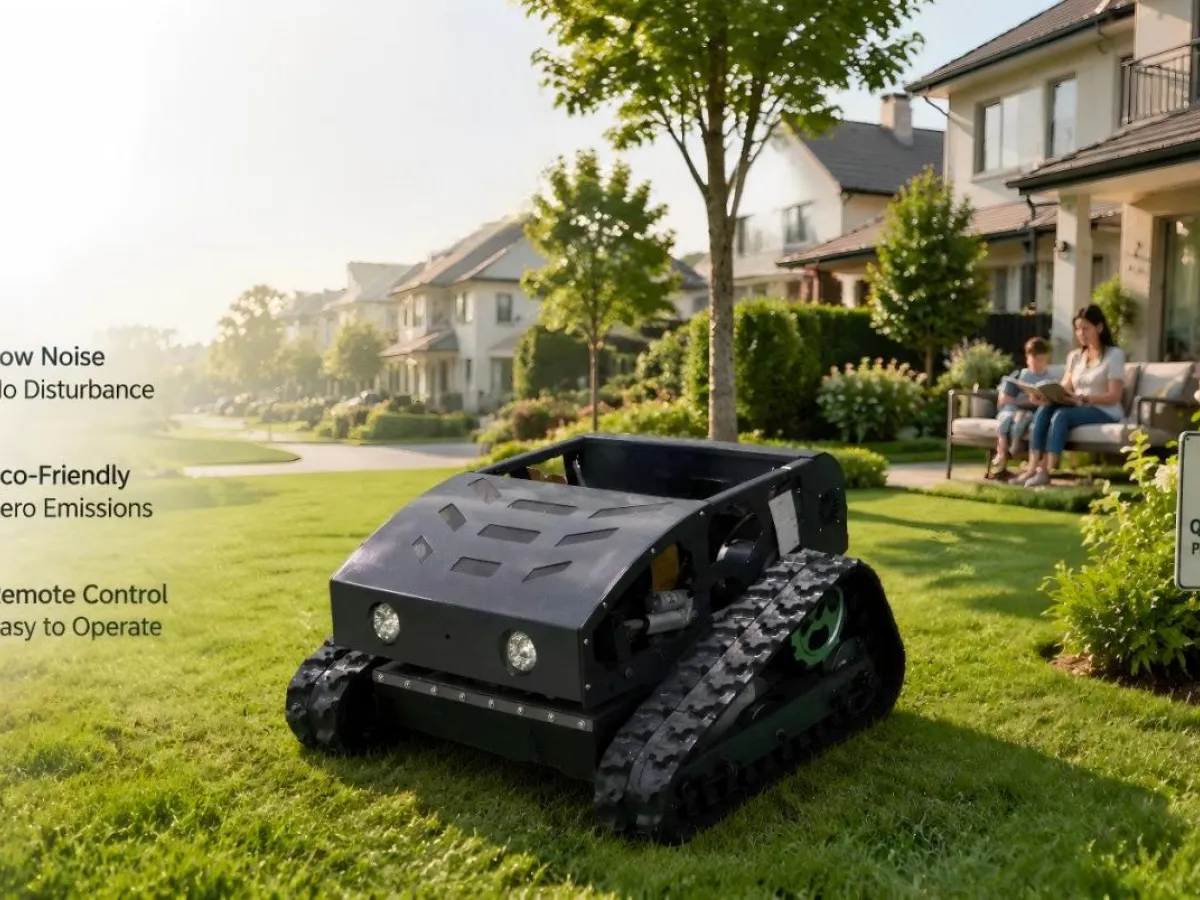
Remote-controlled slope mowers are substantially safer and more efficient than manual slope mowing methods, but they are not silent. A commercial diesel RC mower operating at full deck engagement generates noise levels comparable to a conventional ride-on mower — broadly 75–88 dB(A) at a one-metre reference distance, depending on the model and loading conditions. In urban environments, near residential properties, or in the vicinity of schools, hospitals, and care facilities, this is a meaningful noise level that requires active management.
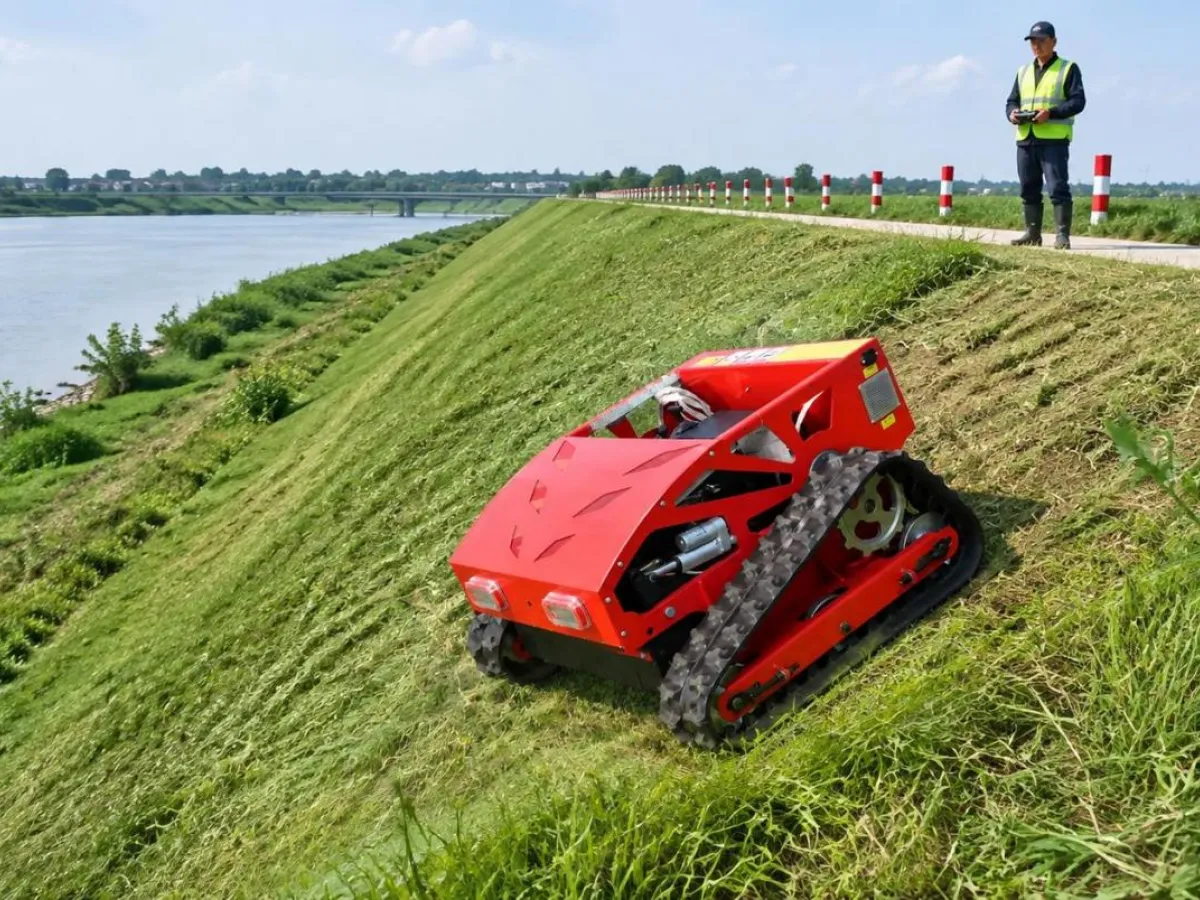
Unlike a conventional ride-on mower where the noise source moves with the operator, an RC mower generates noise in a fixed zone while the operator stands at a distance. For bystanders near the working machine, the noise experience is more continuous and less variable than conventional equipment. Understanding the noise characteristics of RC mowers — and the practical steps available to reduce community impact — is increasingly important as RC mowers are deployed in urban and peri-urban environments.
Understanding RC Mower Noise Data
Manufacturers publish noise data in two forms — understanding the difference is important for site planning:
Sound power level (LWA, dB): The total acoustic energy output of the machine, measured under ISO 11201 or equivalent standards. This is the number typically used for regulatory compliance under the Outdoor Machinery Noise Directive (2000/14/EC). Typical RC mower LWA values: 95–108 dB. This sounds alarming but LWA is not the number you hear at a distance — it is an engineering reference value.
Sound pressure level at operator position (LpA, dB): The noise level experienced by the operator standing at the transmitter position — typically 5–20 metres from the machine. This is the number most relevant to both operator hearing protection requirements and neighbouring property impact. Typical LpA values at 10 metres: 72–82 dB(A) for diesel models; 60–70 dB(A) for electric models.
Noise at property boundary: The noise level experienced by a neighbour at the boundary of the working site depends on the distance from the machine, any intervening barriers, and the directional characteristics of the machine. At 50 metres in open ground, most RC mowers produce 55–65 dB(A) — comparable to a moderately busy road.
Operator Hearing Protection Requirements
Under the Control of Noise at Work Regulations 2005 (UK), employers must take specific action based on daily noise exposure levels:
Action level 1 (80 dB(A) daily exposure): Provide hearing protection to those who request it and provide information on hearing risks.
Action level 2 (85 dB(A) daily exposure): Mandatory hearing protection zones must be established around the machine, and operators must wear appropriate hearing protection.
Exposure limit (87 dB(A)): Must not be exceeded, even with hearing protection.
For most RC mower operators standing 10–15 metres from the machine, daily exposure remains below 85 dB(A) action level 2 during a normal working day. However, operators working close to the machine during setup, inspection, or recovery operations must wear hearing protection rated to at least 25 dB SNR. Include hearing protection in all RC mower operator PPE requirements and conduct periodic noise exposure monitoring on active deployments.
Managing Community Impact: Practical Measures
Effective community noise management for RC mower operations combines planning, communication, and operational controls:
Timing restrictions: The most effective noise management step is to schedule mowing outside periods of maximum community sensitivity. Avoid mowing near residential properties before 8:00 AM or after 6:00 PM on weekdays, and before 9:00 AM or after 5:00 PM on Saturdays. Never mow near residences on Sundays unless contractually required.
Advanced community notification: For regular mowing programmes near residential areas, provide advance notification through local authority channels, estate notice boards, or site management communications. Predictable noise is tolerated significantly better than unexpected noise.
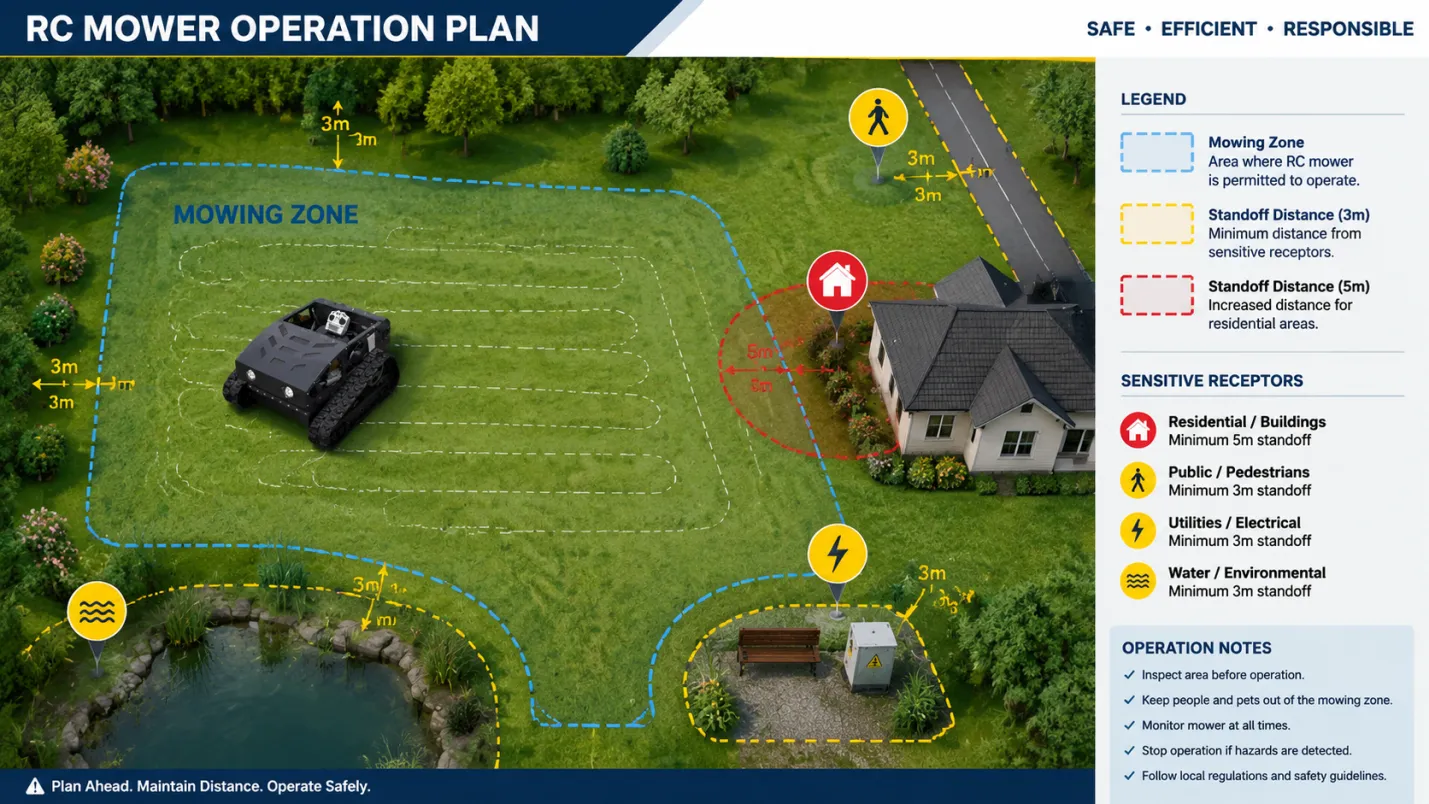
Optimise machine positioning: Where possible, position the machine so that the exhaust outlet faces away from sensitive receptors. On some sites, mowing direction can be chosen to keep the noisiest phase of the operation (deck engagement at full RPM) furthest from the nearest property.
Use natural barriers: Existing vegetation — hedges, tree lines, earth berms — provides meaningful noise attenuation. On sites with existing screening, plan operations to keep the machine within the screened zone for as much of the working day as possible.
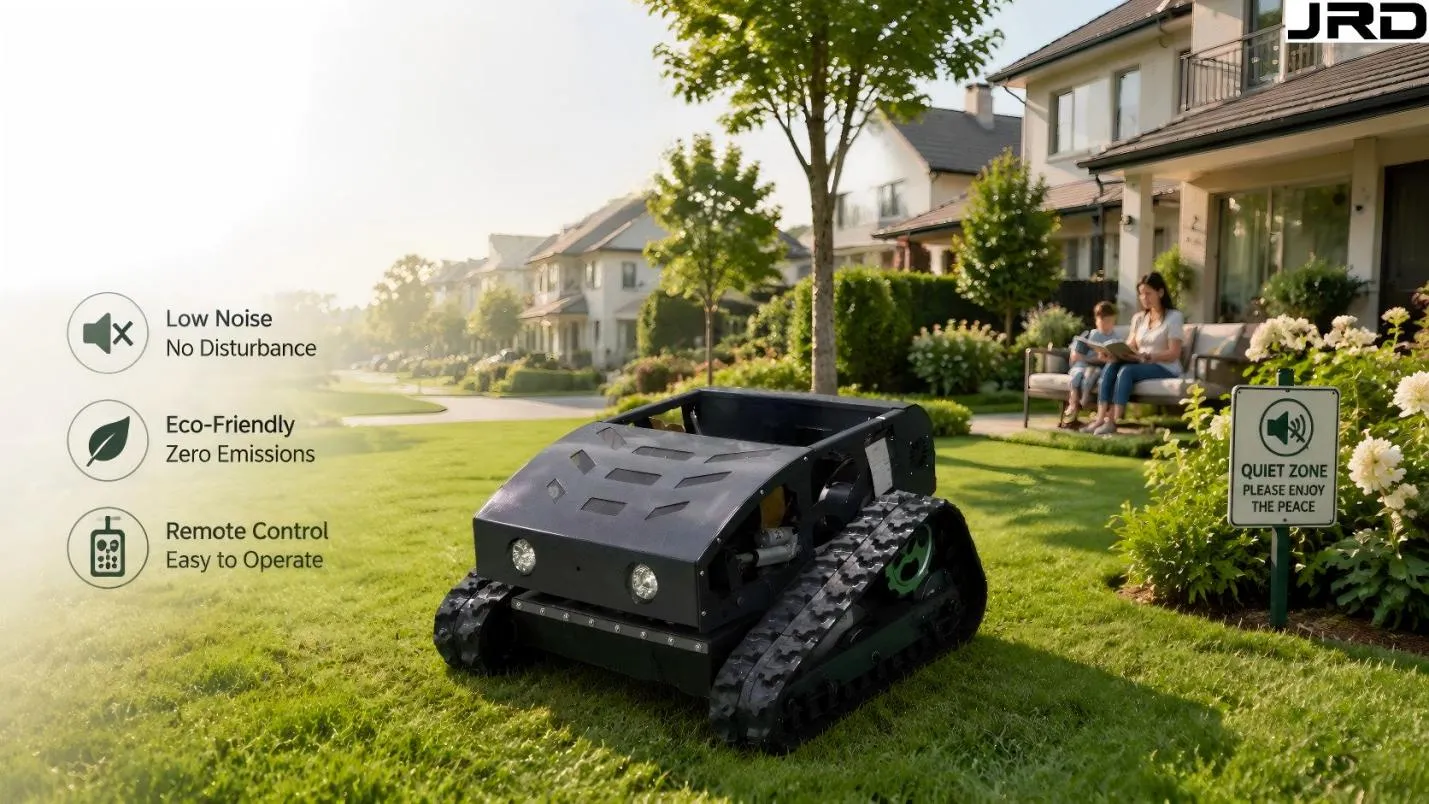
Electric model specification for noise-sensitive sites: Where the contract site is adjacent to a hospital, school, or care home, specify an electric-drive RC mower for significantly lower noise output. Electric RC mowers generate approximately 10–15 dB(A) less noise than equivalent diesel models — a reduction that is clearly perceptible and reduces complaint rates substantially.
Planning Permission and Noise Conditions
In some planning contexts — particularly where RC mower operations are conducted as a regular commercial activity from a fixed depot adjacent to residential properties — permitted development rights may not cover the noise-generating activity without planning permission. Key scenarios where planning noise conditions may apply:
Fixed commercial mowing depot: Operating a fleet of diesel RC mowers from a commercial depot where engines run regularly during maintenance and testing may require planning permission under Use Class B2 (general industrial) and compliance with noise conditions.
Contracted site with noise-sensitive planning conditions: Some contracts — particularly with local authorities and housing associations — include site-level planning conditions that restrict noise-generating maintenance activities to defined hours. Confirm these conditions before scheduling RC mower operations.
Environmental Permit activities: Water company and flood authority mowing contractors may be operating under Environmental Permits that include noise condition compliance reporting.
Responding to Noise Complaints
Despite good planning, noise complaints may arise. Handle them constructively:
Acknowledge the complaint promptly and with courtesy — avoid a defensive response.
Confirm the timing and location of the mowing activity on the date in question.
Provide the complainant with your planned mowing schedule for the site.
Review whether any operational change is practical — earlier start, shorter session, different direction — and communicate what will change.
Log the complaint and your response for quality management records.
Most noise complaints from RC mower operations resolve quickly when the operator communicates proactively. A single call or letter explaining the maintenance necessity, providing a schedule, and showing willingness to adjust where possible typically resolves the issue without formal escalation.
Electric RC Mowers: The Low-Noise Solution
For operators regularly working in noise-sensitive environments, specifying an electric RC mower for those contracts is an increasingly viable business decision. Electric models currently available offer:
Noise reduction of 10–15 dB(A) vs. diesel equivalents — a significant difference that is immediately perceptible and reduces complaint risk.
Zero local exhaust emissions — relevant for enclosed sites, hospital grounds, and any site with sustainability requirements.
Lower maintenance cost (no oil changes, no fuel, fewer moving parts in the drive system).
Currently shorter operational range per charge — typically 2–4 hours of cutting per charge — limiting suitability for large continuous sites without on-site charging infrastructure.
Contact Us
Specifying an RC mower for a noise-sensitive contract? JRD Machinery is an RC slope mower manufacturer and supplier of both diesel and electric models, and can provide measured noise data — sound power level and sound pressure level at operator position — for the exact machine you are considering. We also advise on mowing schedules and community notification wording for urban and peri-urban work. Contact us with your site constraints.
Get in touch for expert advice or a quote:
Email:info@jrdmachinery.com
Website: www.jrdmachinery.com