



Extreme Slope Mowing with RC Mowers Ratings, Technique and Limits
Introduction: Understanding the Upper Boundary of Slope Mowing
Remote-controlled slope mowers exist because there is a category of terrain that no human operator should be mowing on foot or by ride-on machine. But even RC mowers have limits — and approaching those limits without understanding the physics of slope stability, machine traction, and centre-of-gravity behaviour creates its own risks.
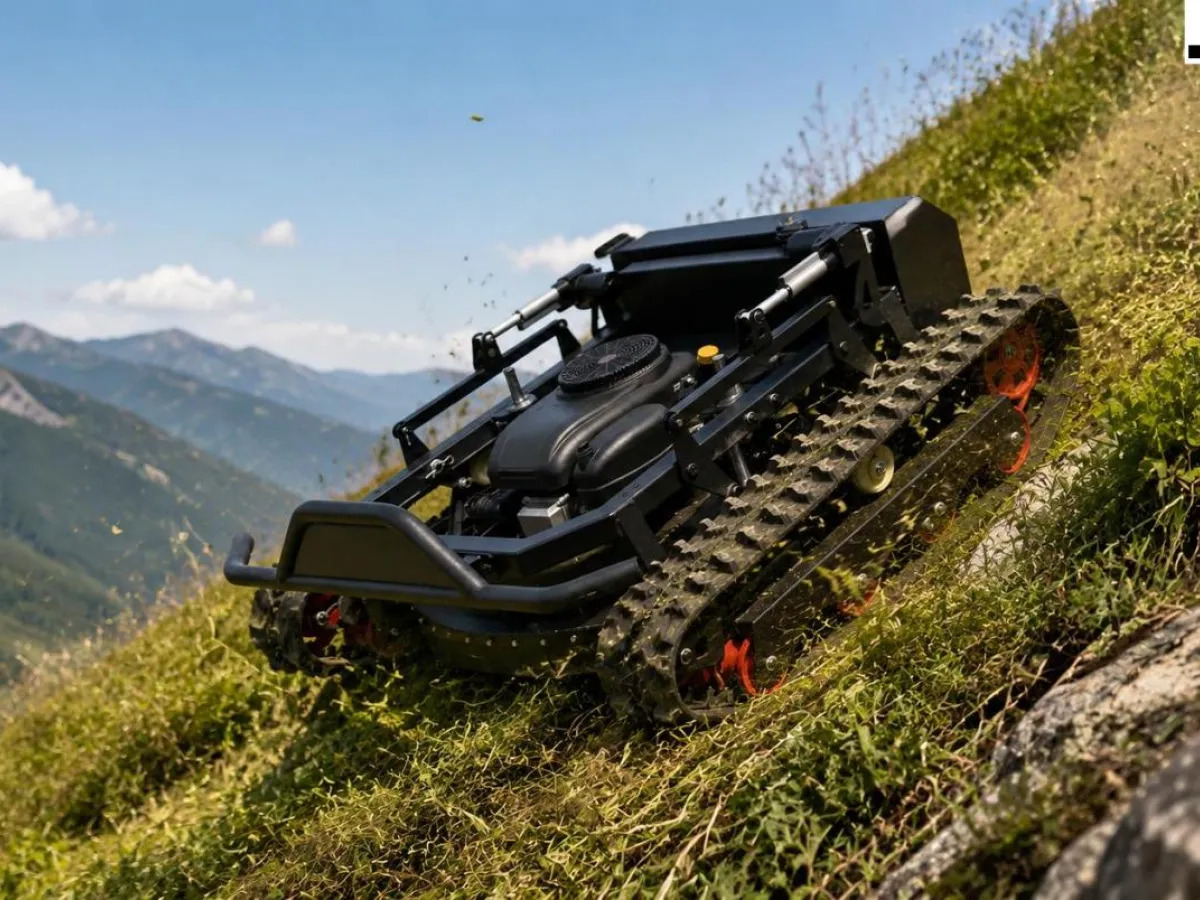
Most commercial RC mowers are rated for slopes between 45 and 60 degrees. Premium models like the STEEPMASTER G-4 are independently certified to operate on gradients up to 55 degrees. The question is not only whether a machine can technically hold position on a given slope, but whether the operator has the technique to control it effectively, and whether the site conditions (wet grass, loose substrate, debris) are compatible with machine deployment on that day.
This article provides the technical foundation for responsible extreme-slope RC mowing: understanding slope ratings, identifying conditions that reduce effective slope capacity, developing the operational technique for high-gradient terrain, and knowing when to stop.
Understanding Machine Slope Ratings
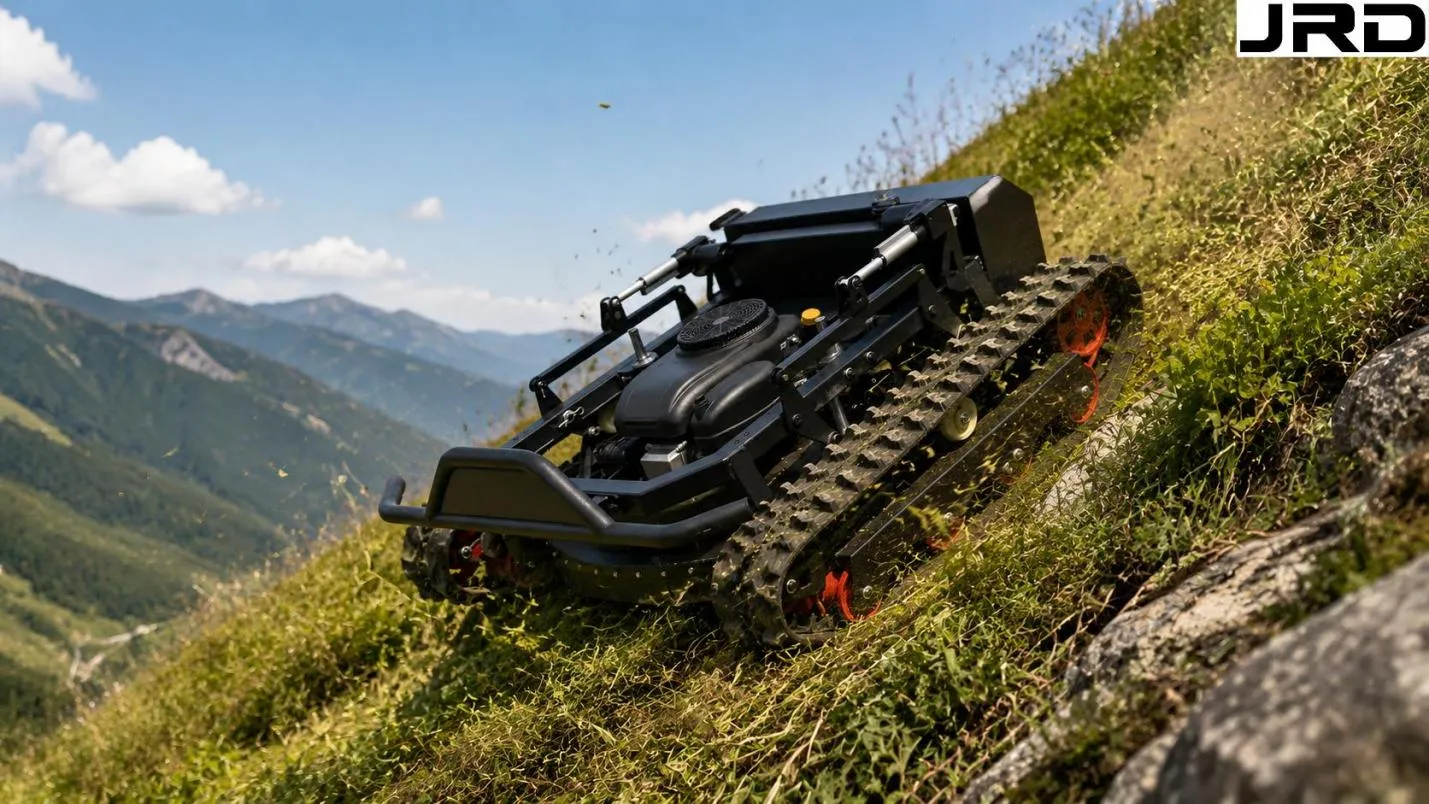
Manufacturers publish slope ratings as the maximum gradient (in degrees) on which the machine has been tested to operate without tipping or losing traction. These ratings are established under controlled conditions — typically on a dry, short-cut grass slope — and represent a ceiling, not a target. Real-world operating margins must account for:
Wet grass: Grass wet from rain or morning dew reduces track traction by 30–40% on typical soil substrates. A machine rated to 55 degrees dry may reach its traction limit at 40 degrees on wet grass.
Long, dense grass: Mowing into long, uncut grass increases the deck drag force, which shifts effective weight distribution and reduces available traction margin.
Loose or soft substrate: Sandy soil, recently turned ground, and saturated clay reduce track grip significantly. Test with a boot pressure test before deploying on any unfamiliar substrate.
Cross-slope (side-hill) operation: Side-slope mowing — where the machine traverses horizontally across a slope rather than ascending or descending — is significantly more challenging than up-down mowing. The lateral tipping moment on side-hill traverses is substantially higher than the forward-backward tipping moment on direct ascent. Many machines rated to 55 degrees for up-down mowing should not be operated beyond 40 degrees on a side-hill traverse without manufacturer confirmation.
Measuring Slope Angle Before Deployment
Never estimate slope angle by eye — human perception of gradient is notoriously inaccurate. Steep slopes consistently look shallower than they are to a standing observer, leading to underestimation. Use:
Digital inclinometer app: Place a smartphone flat against the slope surface to get an accurate degree reading. Multiple apps are available for this purpose.
Physical inclinometer: A bubble inclinometer or clinometer provides a direct field reading without smartphone dependency — preferred in poor-light conditions.
Measure at multiple points: Slopes are rarely uniform — measure at the steepest visible point and at the top and bottom thirds. Use the highest reading as your reference for deployment decision.
If the measured slope exceeds the machine's rated gradient, do not deploy. No production benefit justifies operating outside the manufacturer's rated limits.
Mowing Direction: Up-Down vs. Contour Technique
On gradients above 35 degrees, mowing direction becomes a critical safety variable:
Up-down mowing (perpendicular to contour lines): Recommended for steep gradients above 35 degrees. The machine drives directly up or down the fall line of the slope. This minimises the side-tipping risk because both tracks are always at the same height. The main hazard is runaway on descent if traction is lost — maintain lower speeds on descent and never cut engine power on a descent run.
Contour mowing (parallel to contour lines): Suitable on gradients up to 35 degrees. The machine traverses horizontally across the slope. More efficient for wide slopes but introduces significant side-tipping risk on steeper gradients. Always know the machine's confirmed side-slope limit before attempting contour passes.
Never mow diagonally across a steep slope — this creates the worst combination of forward-backward and side-tipping forces and is a common cause of RC mower loss-of-control incidents on extreme terrain.
Speed Management on High-Gradient Terrain
Speed is the most important operator-controlled variable on extreme slopes. On steeper terrain:
Reduce travel speed to 30–50% of the maximum for the terrain type — slower speeds give more reaction time if traction begins to slip.
On descent passes, engage the lowest travel speed setting before beginning the descent — do not reduce speed after the machine has already started moving downhill at higher speed.
Anticipate the increased inertia of a loaded machine descending — the machine takes longer to stop downhill than uphill.
If the machine begins to slide laterally on a descent, apply full-opposite drive input to steer back onto the fall line — lateral slides on steep terrain rapidly escalate to rollover if not corrected immediately.
If in any doubt, trigger the emergency stop immediately and reassess from flat ground before redeployment.
Emergency Procedures for Loss of Control on Extreme Slopes
Every RC mower operator must be trained in the following emergency responses before approaching high-gradient terrain:
Machine slides or loses traction: Trigger emergency stop immediately. Do not attempt to drive the machine back to control on a sliding surface — this rarely succeeds and often accelerates the slide.
Machine tips onto its side: Trigger emergency stop. The machine will shut down. Do not approach until all blade motion has stopped (minimum 30 seconds). Assess recovery approach from a position of stability before any attempt to right the machine.
Transmitter signal loss: A correctly specified RC mower will fail-safe to all-stop on signal loss. Confirm your machine's fail-safe behaviour in the pre-operation check before any extreme-slope deployment.
Runaway descent: Emergency stop is the first response. Most RC mowers deploy a mechanical brake on the stop command. If the machine continues after emergency stop, immediately establish whether anyone is in the machine's path and clear them from the hazard zone.
Pre-Deployment Extreme Slope Checklist
Before any operation on terrain above 35 degrees:
Measure and record slope angle at steepest point
Confirm angle is within machine's rated limit for prevailing conditions (dry/wet)
Inspect slope surface for loose substrate, embedded rocks, or drainage channels
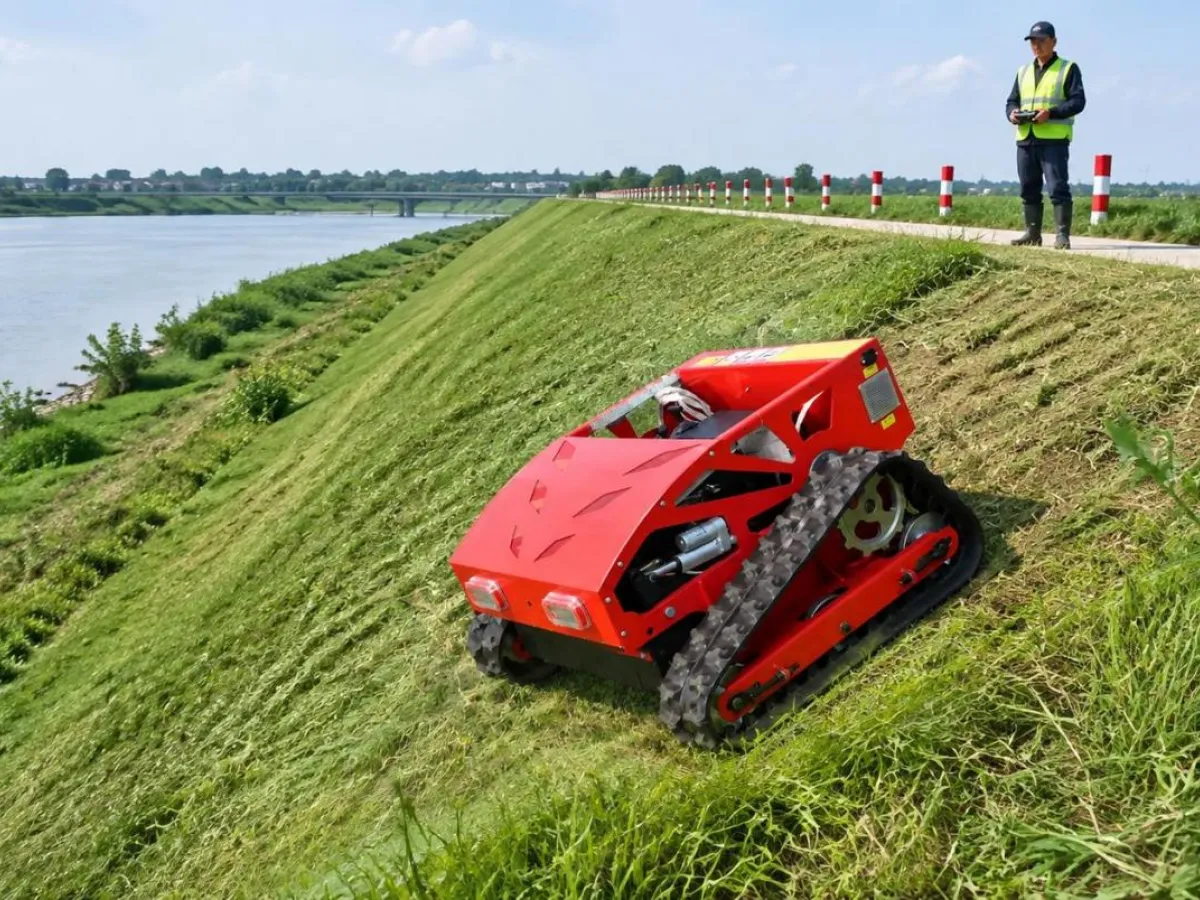
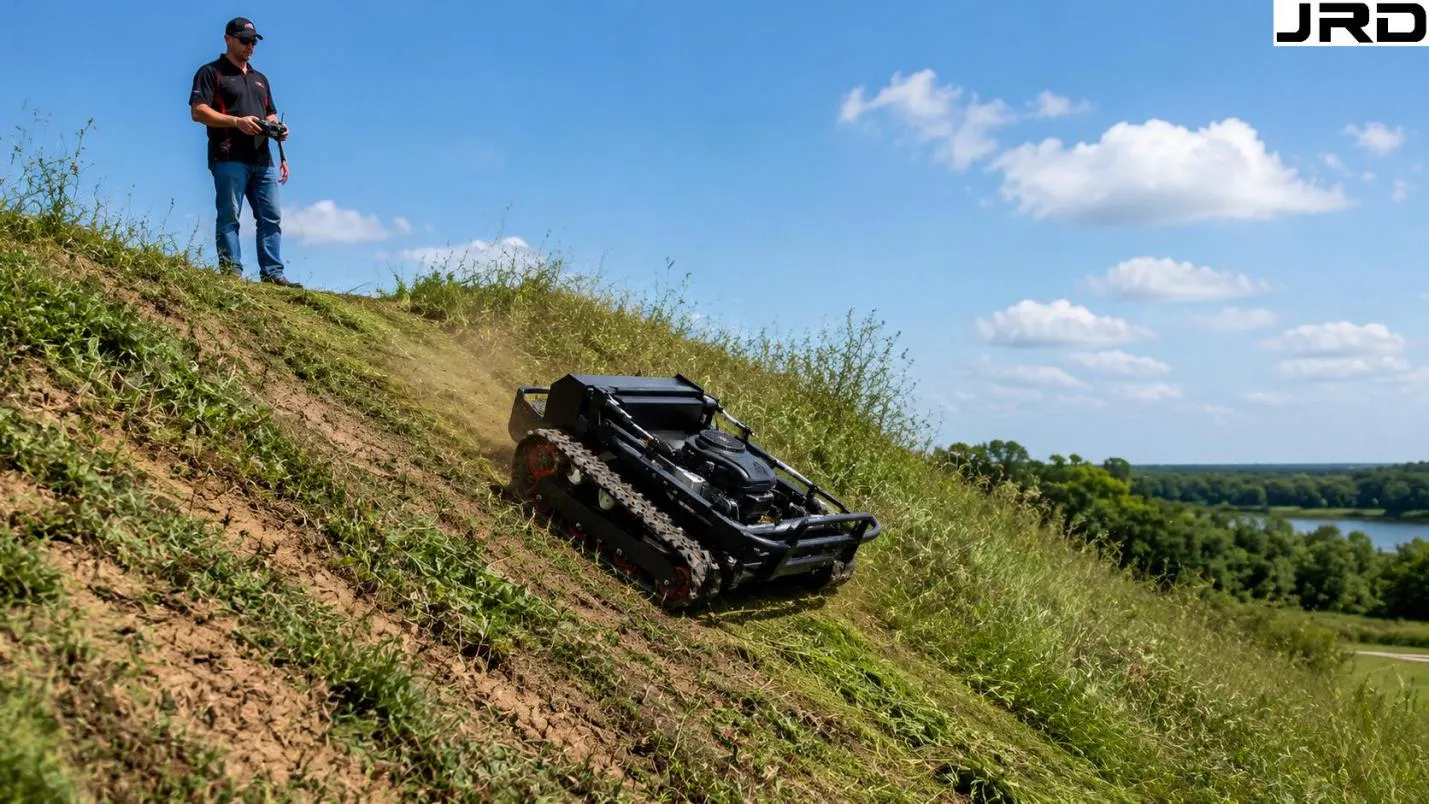
Establish operator positioning — flat ground with clear view of entire slope, not standing on the slope
Confirm exclusion zone covers all ground below machine path
Test emergency stop function on flat ground before deployment
Confirm radio signal quality across the full slope extent
Brief all personnel on exclusion zone boundaries before mowing begins
Contact Us
Working on gradients that demand a certified extreme-slope machine? JRD Machinery is an RC slope mower manufacturer and supplier, and our machines are independently certified to 55 degrees. Every unit ships with slope-rating certification, CE documentation, and operator training materials. We also advise on pre-deployment slope assessment and emergency procedure planning for high-gradient contracts. Contact us to discuss your terrain.
Get in touch for expert advice or a quote:
Email:info@jrdmachinery.com
Website: www.jrdmachinery.com