



Zero Tail Swing Mini Excavators — When the Extra Cost Is Worth It
The specification sheet for a zero tail swing (ZTS) mini excavator looks like most others: operating weight, bucket force, engine power, dig depth. The key difference is not listed as a number — it is the absence of rear overhang beyond the track width when the machine slews. On a conventional excavator, the counterweight swings beyond the tracks. On a ZTS machine, it stays within or very close to the track envelope. That geometric difference is either irrelevant to your work or it changes everything about what the machine can safely do on a given site.
This article explains what the zero tail swing design involves, where it earns its price premium, and the situations where a conventional tail overhang machine is the better purchase.
What Zero Tail Swing Means — and What It Does Not
A ZTS mini excavator keeps the counterweight within (or within 50–100 mm of) the outer edge of the tracks when the machine slews 360 degrees. This is achieved by shortening the rear frame, redesigning the counterweight geometry, and in some cases reducing the counterweight mass — which affects stability and requires other design compensations.
What ZTS does not mean: the boom and arm still extend beyond the track width when working. The benefit of ZTS is rear-end clearance, not side clearance. A contractor who assumes a ZTS machine has no swing hazard on any side is misreading the specification.
• Rear clearance: the machine can slew next to a wall, fence, or vehicle without the counterweight striking it — this is the primary benefit
• Side clearance: unchanged from a conventional machine; the boom and attachment still require clear swing arc
• Digging efficiency: ZTS machines typically have slightly reduced stability at maximum reach because the counterweight mass is constrained by the design requirement. The effect is most noticeable at full extension with heavy buckets
• Cost: ZTS machines carry a price premium — typically 5–15% over equivalent-class conventional machines — because the engineering and manufacturing tolerances are tighter
Where ZTS Pays for Itself
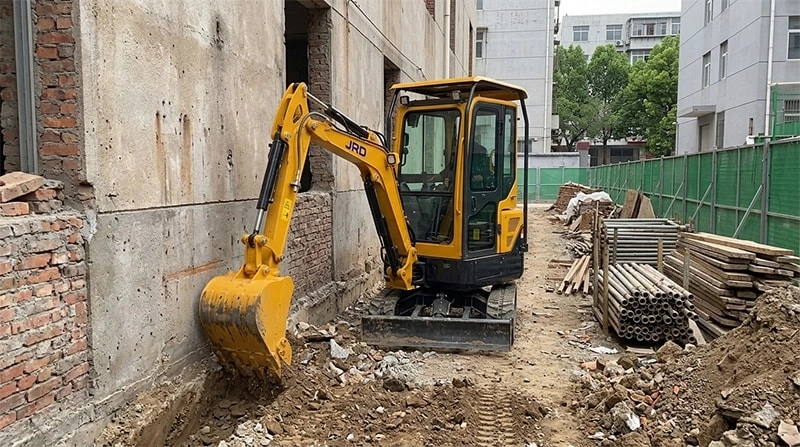
Urban demolition and renovation: working inside a building footprint, between walls, or in a courtyard where the counterweight of a conventional machine would contact the structure on every slew cycle. A single collision incident can cost more than the ZTS premium.
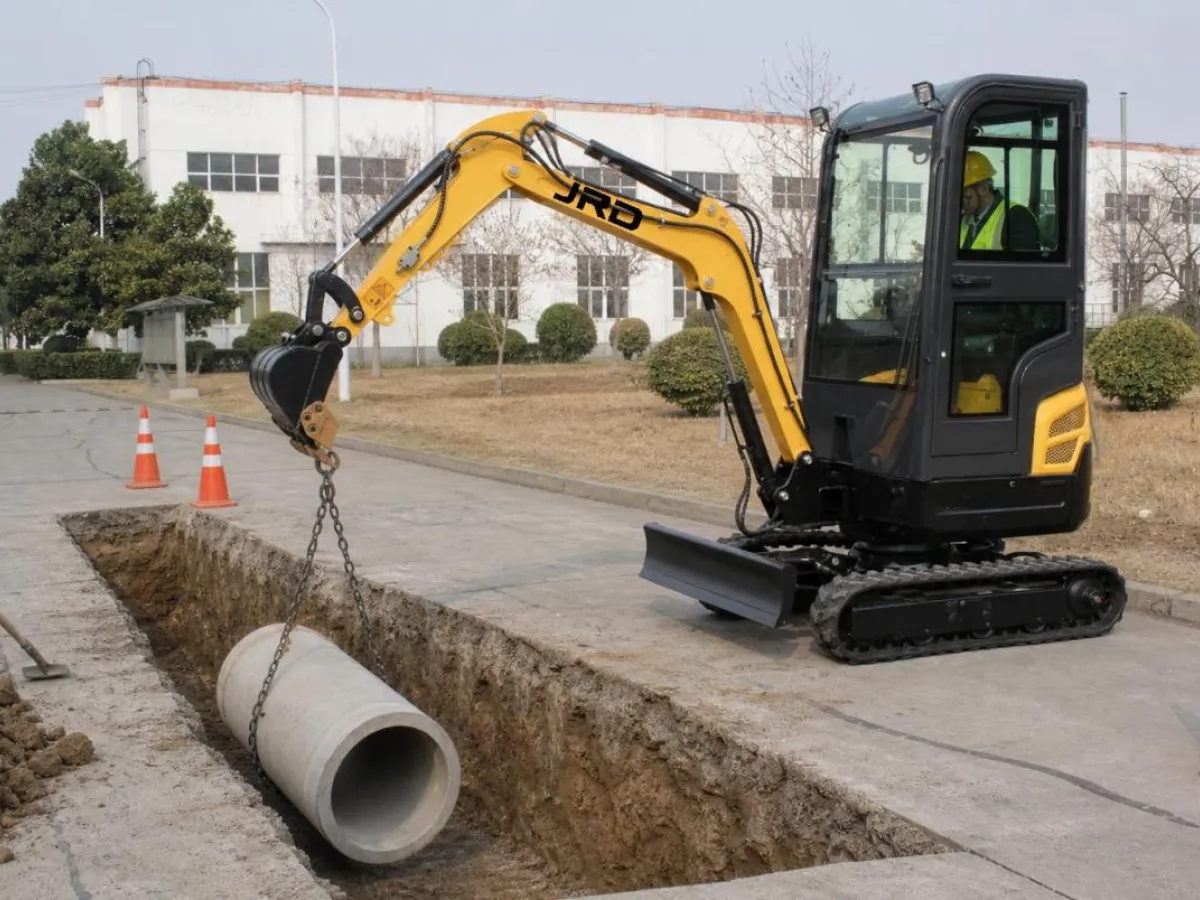
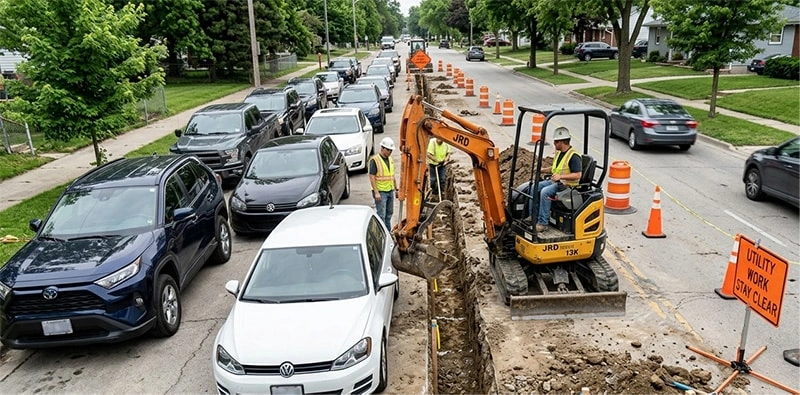
Roadside utility work: the machine is positioned on the carriageway shoulder with traffic on one side and the dig on the other. The rear of the machine cannot swing into the traffic lane. A ZTS machine maintains this requirement without restricting slew angle or requiring additional traffic management.
Confined residential sites: side access through gates, narrow garden spaces, and work between buildings in row-house or townhouse settings where the machine is always within 1–2 m of a boundary. The 16 series with telescopic undercarriage and ZTS configuration addresses this scenario — it narrows to pass through a gate and keeps its counterweight clear of adjacent structures once positioned.
Pipeline trenching in right-of-way: working in a defined ROW with fencing, permanent structures, or service equipment on both sides. ZTS machines allow dig operations without requiring constant site clearance checks before every slew.
Where Conventional Tail Overhang Is the Better Choice
Open rural and agricultural sites: no structures within swing radius, no traffic, no boundary constraints. A conventional machine costs less, digs with higher stability at reach, and carries heavier attachments without compromise.
Heavy-duty digging: for machines in the 17 series to 25 series working in hard material with maximum breakout demand, the conventional counterweight design maintains stability across the dig cycle more consistently than a constrained ZTS counterweight. At these weights, the rear geometry compromise in ZTS design can reduce rated lift capacity at full reach by 8–12%.
Attachment-heavy operation: running a hydraulic breaker or heavy rock bucket pushes load to the front of the machine. Conventional counterweight geometry better balances this without tipping risk at the operating weights involved.
Cost-sensitive procurement: for hire fleets or contractors who do not regularly work in confined sites, the ZTS premium is not recovered in utilisation benefit.
ZTS Options in the Product Range
Within the compact excavator range, ZTS configuration is most commonly available in the 10 series through 18 series weight class. The 12 series and 13 series ZTS machines are the most commonly requested for residential renovation work — at this class, the machine is light enough to pass through standard access while still carrying useful dig force (7–11 KN) for the tasks involved.
The 16 series with telescopic undercarriage in ZTS configuration represents the most versatile option for contractors who regularly move between confined residential sites and open sites — the track extends for open-site stability and retracts to ZTS clearance width for confined access.
When ordering a ZTS machine, confirm the tail swing radius specification precisely — some manufacturers advertise machines as ZTS when they have 50–100 mm overhang beyond the tracks. True zero tail swing means the counterweight stays within the track width at all slew angles. A 50 mm overhang may be acceptable for some applications; in others, it is the difference between clearing a wall and contacting it.
Operating Discipline With ZTS Machines
ZTS machines create a false sense of complete rear clearance. The operator must still:
• Check the swing arc of the boom and attachment — these still extend well beyond the track width
• Verify the 50–100 mm tolerance — even a ZTS machine has some overhang at defined radii; know the spec of your specific machine
• Never slew faster than visual clearance allows — the machine can still contact overhead, lateral, and forward obstacles
• Check ground conditions at the rear — a ZTS machine can still tip backward if the ground behind the tracks gives way
Conclusion
A zero tail swing mini excavator solves a specific problem: rear clearance during slew in confined sites. If your work regularly places the machine within 1 m of a structure, wall, or traffic on the rear quarter, the ZTS premium is recoverable in reduced incident risk and avoided site management cost.
If your sites are open, the material is hard, or the budget is fixed, a conventional machine at the same weight class gives better stability, higher rated capacity, and lower acquisition cost. The ZTS decision is a site-type decision, not a machine-quality decision.
Contact Us
Zero tail swing solves a specific problem: rear clearance during slew in confined sites. Whether your work regularly places the machine within a metre of walls, traffic, or structures—making the ZTS premium a clear return on reduced incident risk—or you need a conventional machine for open-site stability and heavier digging, JRD Machinery can match the configuration to your site type and budget. Contact us with your typical working environment for a recommendation.
Email: info@jrdmachinery.com
Phone: +86 136 9536 6564
Website: www.jrdmachinery.com