



Mini Excavator Engine Comparison — Kubota, Laidong, Kohler, and What Each One Means for Your Operation
The engine is the component on a mini excavator that buyers pay least attention to during purchase and most attention to during ownership. A hydraulic hose can be replaced at a farm supply store. A track can be ordered and fitted in a morning. An engine that needs a rebuild, or that you cannot source parts for locally, stops the machine for weeks.
This article compares the engines most commonly fitted to compact excavators in the 660 kg to 2,500 kg range — Kubota, Laidong, Kohler, and Briggs & Stratton — and explains what the differences mean in service, parts availability, and suitability for specific operating environments.
What to Evaluate When Comparing Engines
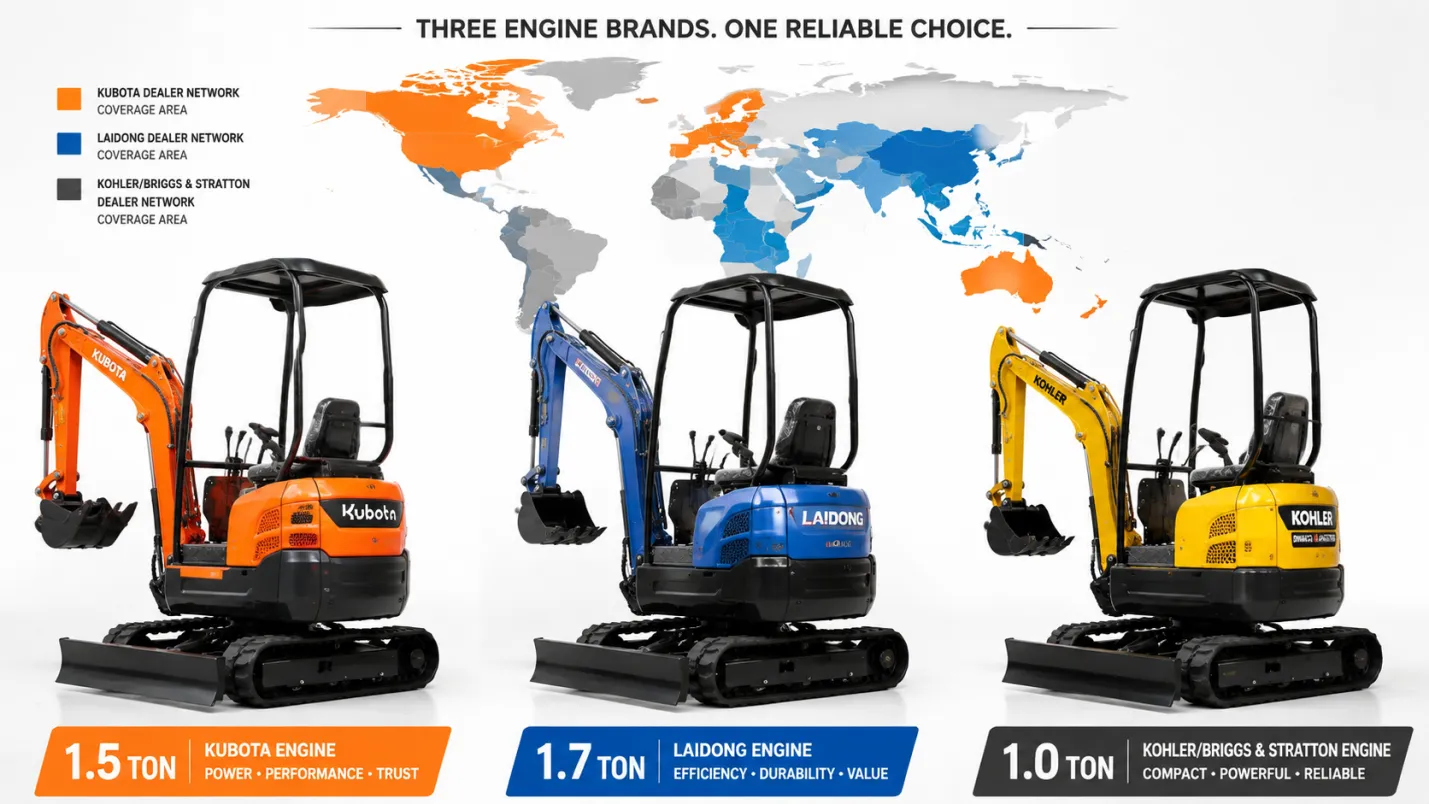
Parts availability: can you source filters, belts, injectors, and overhaul parts locally in your market? An engine with distribution networks in your region costs less to maintain than one where parts must be imported
Service interval: longer oil change intervals mean fewer service events per year at typical utilisation — this affects both labour cost and machine downtime
Heat management: compact excavator engine bays are small; engines that run hot under sustained load stress the cooling system and the hydraulic oil simultaneously. Look for engines with adequate cooling fan capacity for the power output
Emissions certification: for markets requiring EPA Tier 4 or EU Stage V compliance, the engine choice is constrained — not all engines meet these standards
Cold start performance: in cold climates, engines that require glow plug warm-up or that have narrow oil viscosity tolerance create operational problems in winter
Kubota — The Global Benchmark
Kubota diesel engines — primarily the D722 (three-cylinder, 14 HP/10.2 kW) and the D902 series — are the most widely specified engines in the global compact equipment market. Their dominance in this class comes from two attributes that matter more than raw power output: parts network depth and known service behaviour
In most agricultural and construction markets, Kubota parts are available at local dealers, farm supply chains, and equipment distributors. The D722 filter and service kit can be sourced in most countries without special ordering. This is the single largest practical advantage of the Kubota-engined 15 series and 18K Pro series machines — wherever they operate, they can be maintained.
Technical characteristics of the D722 in compact excavator service:
Power output: 10.2 kW (13.9 HP) at 3,000 rpm — adequate for 1,350–1,500 kg class machines in all soil types except sustained heavy rock
Service interval: 200 hours oil change standard; extended to 500 hours with approved synthetic oil and clean operating conditions
Cooling: liquid-cooled; consistent thermal management at sustained load unlike air-cooled alternatives
Emissions: meets EPA Tier 4 Final and EU Stage IIIB/IV in variants — important for import compliance in regulated markets
Cold start: glow plug pre-heat system; reliable cold-start down to approximately -15°C with standard specification diesel
The limitation of the Kubota D722 is power — at 10.2 kW, it reaches its operational limit in sustained heavy-breakout applications with a rock bucket or breaker. For those applications, the 17 series and 22 series machines are specified with higher-output engines.
Laidong — High Output in the Mid-Class Range
Laidong engines — primarily the KM385B (18.1 kW/24 HP) and the LL380 series (18.4 kW/25 HP) — are the primary power units in the 17 series and 17K series compact excavators. At this power level, they deliver meaningfully more hydraulic output than the Kubota D722 and support the variable piston pump and Taifeng multi-way valve architecture that characterises these models.
The Laidong KM385B in particular pairs well with the 17 series' hydraulic specification:
Power output: 18.1 kW (24 HP) at 2,600 rpm — the highest power in the compact excavator range at this machine weight
Torque curve: flat torque delivery between 1,800 and 2,600 rpm, which matches the variable piston pump's demand curve well — no hunting under varying load
Cooling: liquid-cooled with large-format radiator; maintains stable operating temperature during sustained breaker or mulcher operation
Parts availability: strong in China and Southeast Asian markets; less established in European and North American markets than Kubota, though improving
Emissions: EPA Tier 4 Final certified in current production — important for import into regulated markets
For contractors in markets where Laidong has established distribution, the KM385B is the performance choice in the 1,400–1,700 kg class. For export to markets where parts sourcing is uncertain, confirm the distribution network before specifying.
Kohler and Briggs & Stratton — The Sub-1,000 kg Range
Kohler (primarily the CH440 and XR series) and Briggs & Stratton (primarily the XR 13.5 series) are the most commonly fitted engines in the 10 series, 12 series, 13 series, and 15K series compact excavators. At 10–13.5 HP, these engines match the dig force requirements of sub-1,250 kg machines.
Both are air-cooled single or twin-cylinder petrol or diesel engines. In the compact excavator application, they are typically specified as diesel variants. Their characteristics:
Kohler XR/CH series: robust construction, reasonable parts availability in markets where Kohler has outdoor power equipment distribution, 250-hour service interval on standard specification
Briggs & Stratton XR 13.5: wide distribution through outdoor power equipment channels — hardware stores, farm supply, and rental equipment dealers stock filters and service parts in many markets
Air-cooled thermal behaviour: both engines run hotter under sustained load than liquid-cooled alternatives. On full-day operation in hot ambient temperatures (above 35°C), monitor for thermal cycling that stresses head gaskets over time. Ensure the engine bay ventilation is clear of debris before extended operation
Cold start: air-cooled engines are more sensitive to cold than liquid-cooled; in sub-zero ambient temperatures, additional warm-up time is needed before applying load
Engine Choice by Application
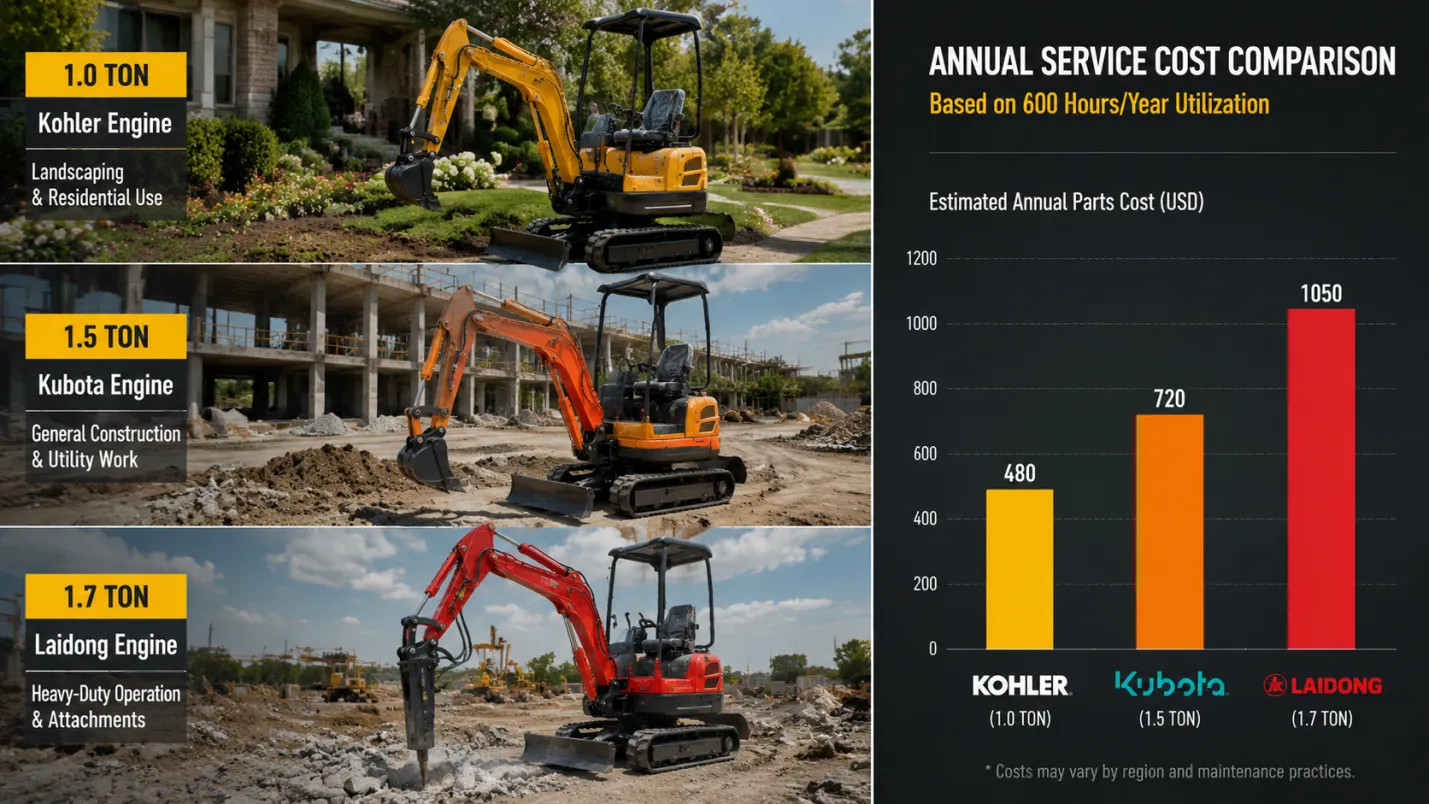
Residential landscaping and light utility (sub-1,000 kg machines): Kohler or Briggs & Stratton in the 10–13.5 HP range is adequate. Parts availability through outdoor power equipment channels makes service straightforward.
General contractor use (1,000–1,500 kg machines) in markets with Kubota distribution: the Kubota D722-powered 15 series is the default choice — power is sufficient for most residential and light commercial work, and service support is the broadest available.
Attachment-intensive work (breaker, mulcher, thumb on the same machine) in 1,400–1,700 kg class: the Laidong KM385B-powered 17 series provides the hydraulic output that attachments demand. The higher power output and variable piston pump deliver consistent auxiliary flow without the power drop seen when smaller engines run accessories simultaneously with the main dig circuit.
Export markets with regulated emissions requirements: confirm EPA Tier 4 or EU Stage V certification on the specific engine variant before purchase. Not all production variants of each engine family meet the latest regulations.
Remote operation with limited service access: specify the Kubota D722 regardless of power trade-off. The network depth for parts and service support globally outweighs the power advantage of other options when the alternative is a broken machine with no local service support.
Service Cost Comparison
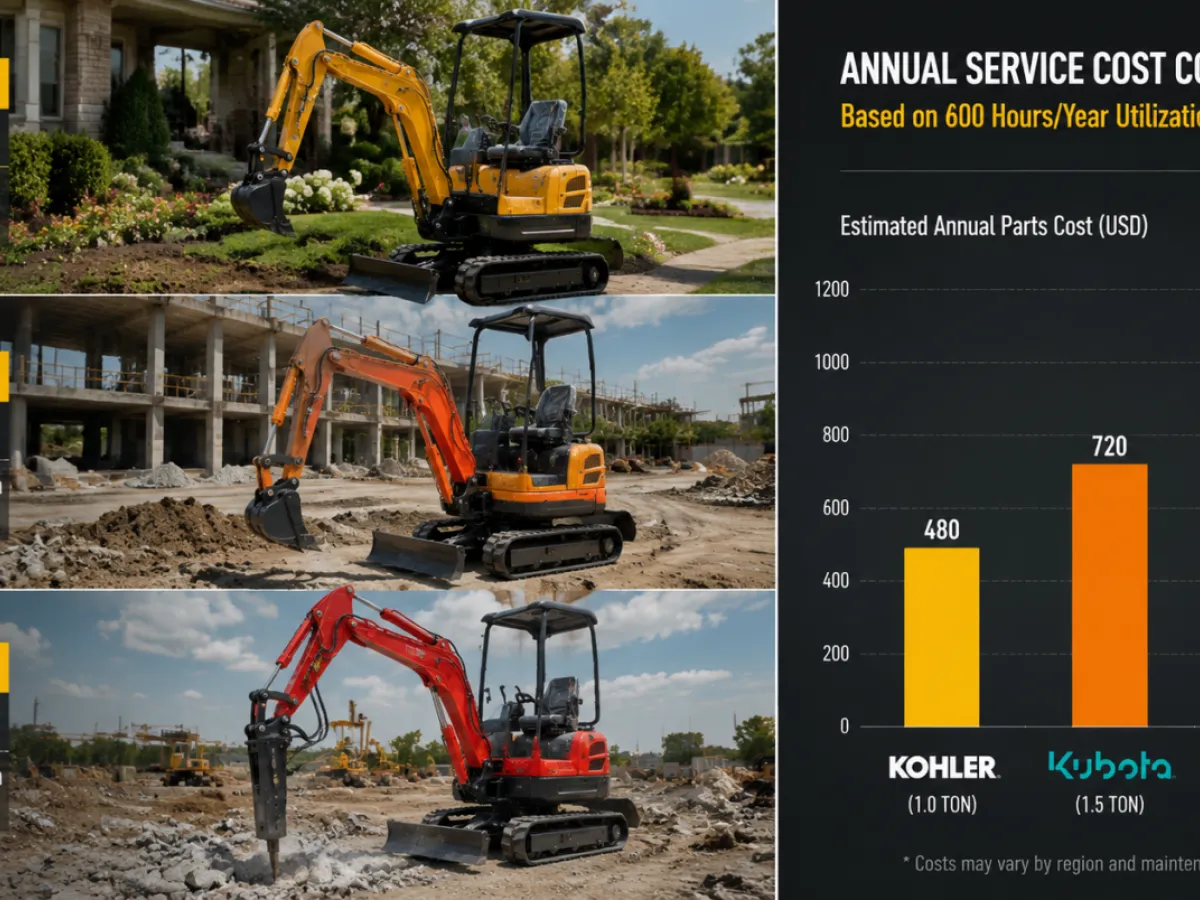
Approximate annual service cost per engine at 600 hours/year utilisation:
Kubota D722: oil filter, air filter, fuel filter, coolant check — approximately $80–$120/year in parts at 200-hour intervals (3 services/year)
Laidong KM385B: similar service schedule — approximately $90–$130/year in parts where distribution is established; 15–30% higher where parts must be imported
Kohler/B&S XR 13.5: approximately $60–$80/year in parts through hardware distribution channels — the lowest parts cost, offset by more frequent service in demanding conditions
These figures are parts cost only. The labour to perform service is typically 30–60 minutes per event for an experienced technician — the main variable is access to service points in the engine bay, which varies by machine design rather than engine brand.
Conclusion
For most buyers, the engine choice in a mini excavator is a parts availability decision first and a performance decision second. The Kubota D722 wins on global parts network. The Laidong KM385B wins on output at the 1,400–1,700 kg class. The Kohler and Briggs & Stratton options win on accessible service parts at the sub-1,000 kg end.
The worst outcome is specifying an engine for its power output in a market where parts are not stocked — the performance advantage disappears immediately when the machine sits waiting for a filter that takes three weeks to arrive. Match the engine to your market's service infrastructure, and the performance follows.
Need a compact excavator that works corners, walls, and confined zones without constant repositioning?
JRD Machinery offers CE-certified mini excavators with boom lateral swing on the 16, 22, and 25 series — including telescopic chassis and pilot control options for professional site work.
Visit www.jrdmachinery.com to compare specifications, or contact us for a model recommendation based on your specific site requirements and export destination.
Email: info@jrdmachinery.com
Whatsapp: +86 136 9536 6564
Website: www.jrdmachinery.com