



Mini Excavator Quick Coupler — Changing Attachments Without Losing the Afternoon
An excavator that takes forty minutes to change a bucket is an excavator that stays in its primary configuration all day, even when the job would benefit from switching. Mini excavator quick coupler systems solve this by converting a task that requires removing and reinserting physical pins with a hammer into a two-minute hydraulically controlled connection. For contractors who run mixed-task days — trench in the morning, auger post holes at lunch, grade in the afternoon — the quick coupler is not an accessory; it is what makes single-machine versatility actually viable.
This article covers how quick coupler systems work, the pin dimension compatibility question that determines whether a coupler can pick up third-party attachments, hydraulic quick coupler operation for wet-line attachments, and the attachment range that the compact excavator supports.
How Quick Couplers Work — The Mechanism Behind the Time Saving
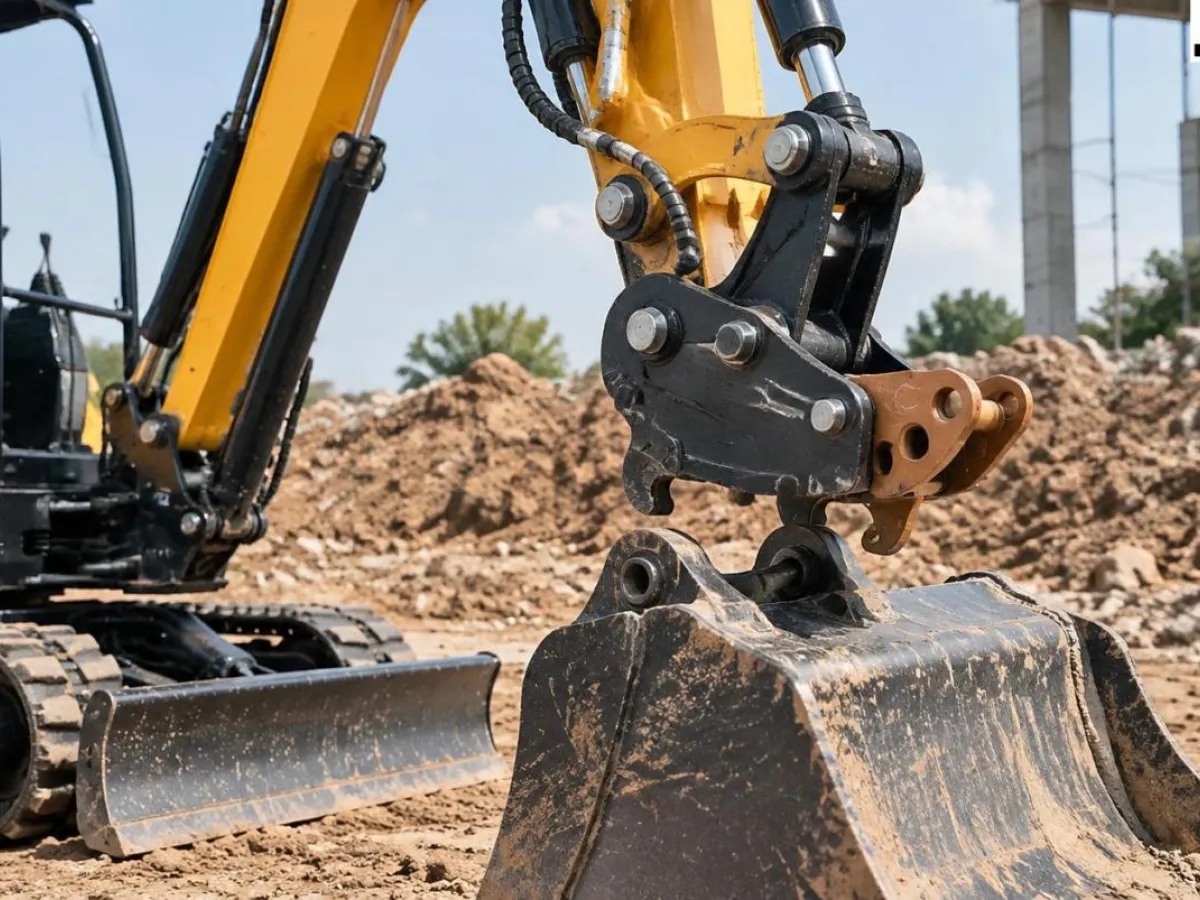
A mini excavator quick coupler replaces the two manual pivot pins that connect the bucket or attachment to the arm tip with a powered jaw mechanism. The coupler body bolts permanently to the arm tip using the same pin holes as a direct attachment, but instead of connecting directly to the attachment, it connects to a standardised receiver head on each attachment.
The receiver head has two cross-pins at fixed spacing — matching the jaw width of the specific coupler. When the operator positions the coupler over the attachment, the front jaw engages the first pin, then the rear jaw swings down under hydraulic pressure to capture the second pin. A lock pin or wedge mechanism holds both jaws engaged. The whole sequence, properly performed, takes 90 seconds to two minutes. Releasing the attachment reverses the sequence: unlock, open rear jaw, back away from the attachment.
The critical dimension in coupler compatibility is pin spacing and pin diameter. A coupler designed for 40 mm pins at 175 mm spacing will not pick up an attachment with 45 mm pins at 195 mm spacing — the jaws will not engage correctly and the connection will be unsafe. When sourcing attachments from third-party suppliers, always confirm pin diameter and pin centre-to-centre spacing against the coupler specification. Attachments built for the same machine weight class from different manufacturers are often similar but not always identical in these dimensions.
Pin-On Attachment vs Quick Coupler — When the Old Way Is Still the Right Way
Pin-on (manual pin) attachment connections are not obsolete, and for some applications they remain preferable. In heavy rock breaking or high-impact demolition work, the coupler introduces an additional connection point between the arm and the attachment that must absorb impact loads with every breaker cycle. In some breaker applications, the vibration and repeated shock loads can cause premature wear in the coupler jaw bushings. For contractors running a breaker as their primary daily attachment — who change attachments infrequently and run continuous high-cycle breaking work — a direct pin-on connection between the arm and the breaker bracket is more durable.
For contractors who genuinely change attachments daily or several times per week — landscapers, multi-trade contractors, hire fleet operators — the productivity gain from a quick coupler far outweighs the wear consideration. The time saving alone typically pays back the coupler cost within six months of regular multi-attachment use. The calculation is straightforward: if a 40-minute attachment change happens three times a week, that is two hours of lost production per week. At a typical hire rate, a quick coupler pays for itself in less than one season.
The Attachment Range and What Each One Is Actually For
The compact excavator attachment range covers tools for most earthmoving, demolition, landscaping, and utility tasks. Understanding what each does in practice helps in building an attachment set that actually covers the planned work profile rather than duplicating capability.
The standard digging bucket in 200 mm and 400 mm widths covers trench excavation and general digging. The 200 mm width produces a neat trench for pipe or cable duct at minimum width; the 400 mm width handles footing and general soil removal at higher cycle volumes. In rock or compacted fill, bucket teeth (replaceable) are the primary wear item — inspection and replacement of worn teeth is a maintenance task that operators should check at every 100 hours.
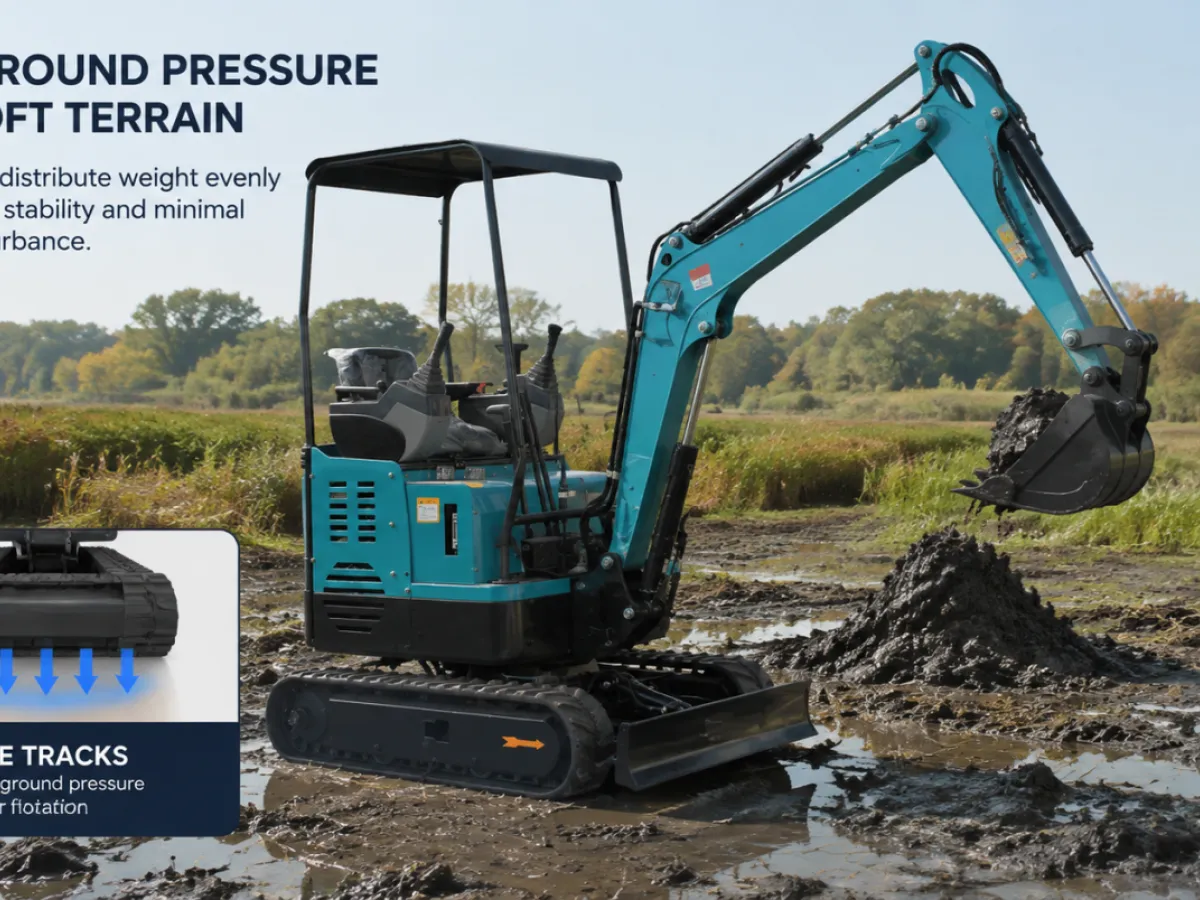
The mud bucket (wide, toothless, flat-profile) handles soft and wet material that a toothed bucket churns rather than moves cleanly. Drainage trench work, pond clearing, and topsoil stripping over wet ground all benefit from the mud bucket's flat base and higher-volume capacity in loose material.
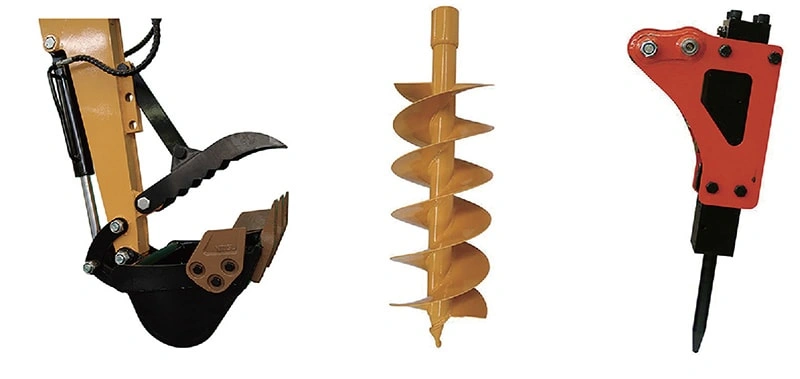
The single-tooth ripper — one large steel tooth mounted where the bucket would sit — is used for breaking compacted material that a digging bucket would bounce off, and for running trenches through root systems that a bucket tooth cannot cut. Rippers are not for rock-hard ground in most compact excavator applications — that requires a hydraulic breaker — but for material between "hard dig" and "requires breaking," the ripper is the faster and simpler tool.
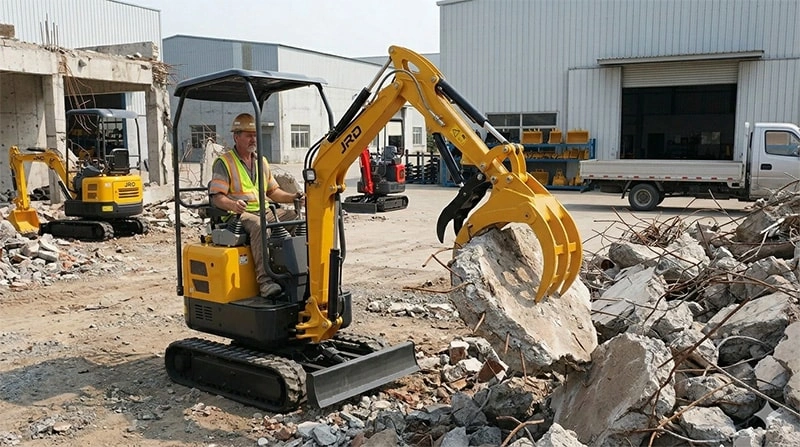
The log grapple is a hydraulic attachment — it requires the auxiliary hydraulic circuit — and is used for handling timber, demolition debris, and aggregate. In landscaping applications with tree removal, the log grapple allows the excavator to pick up and sort cut timber without manual handling. In demolition, it handles loose concrete sections and brick debris. The grapple is the attachment that most clearly illustrates the value of auxiliary hydraulic flow on a compact machine.
The hydraulic thumb is a single curved arm that clamps against the bucket to create a grab. It handles irregular-shaped material that a bucket alone would drop — rocks, root balls, broken pipe sections. The thumb is particularly useful in compact site demolition and salvage work where the operator must be selective about what is picked up and what is left.
Hydraulic Compatibility for Wet-Line Attachments
Hydraulic attachments — log grapple, auger, hydraulic thumb, hydraulic breaker, tilting bucket — require oil flow from the machine's auxiliary circuit through hydraulic hose connections (the "wet lines") at the arm tip. Machines without auxiliary circuit provision cannot run these attachments unless the circuit is added — a factory option, not a field modification, on most models.
The mini excavator quick coupler system and the wet-line circuit should be specified together when hydraulic attachments are planned. The wet-line connections (typically two hydraulic hose ports at the arm tip) must be present before the coupler can engage a hydraulic attachment — the coupler itself does not add the hydraulic circuit. On models where the auxiliary circuit is listed as an option, it should be ordered at the point of machine purchase, not attempted as a retrofit.
Flow and pressure matching between the machine's auxiliary output and the attachment's rated requirements was covered in Article 56 for auger drills specifically. The same principle applies to all hydraulic attachments: confirm the attachment motor or cylinder rated flow and pressure against the machine's auxiliary output before ordering. An underpowered auxiliary circuit will stall the attachment; an oversized output will overheat the circuit through the attachment's relief valve. The match between machine and attachment is a specification conversation, not an assumption.
Building a multi-attachment mini excavator specification for your work profile?
JRD Machinery supplies CE-certified compact excavators with quick coupler and wet-line auxiliary circuit options, plus a full attachment range including buckets, mud buckets, rippers, log grapples, auger drills, and hydraulic thumbs.
Contact Us
If you are looking for a reliable quick coupler system for your mini excavator — or need help matching pin sizes, wet-line circuits, and attachments to your machine — feel free to contact us:
Email: info@jrdmachinery.com
Phone: +86 136 9536 6564
Website: www.jrdmachinery.com