



When the Ground Doesn't Cooperate — Mini Excavator Undercarriage and Travel System
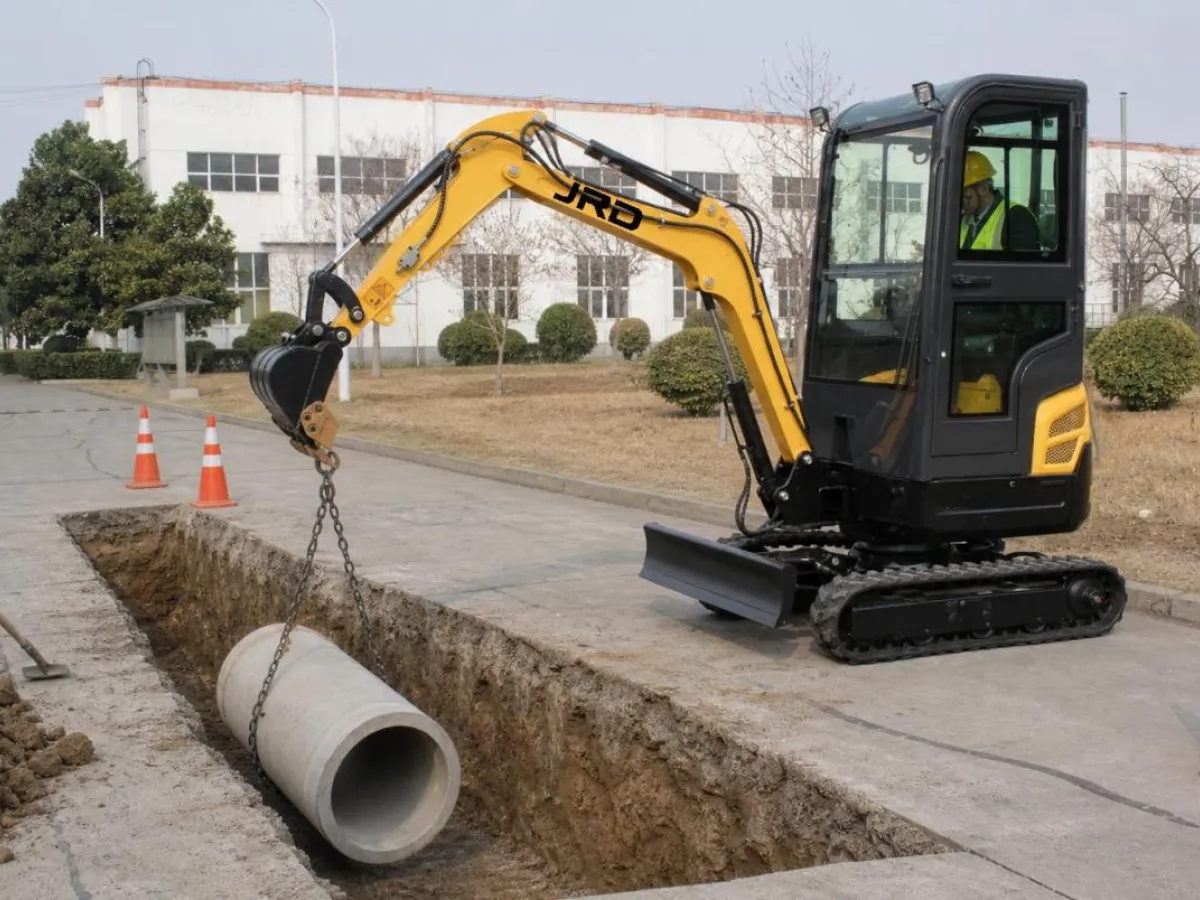
Most buyers ask about digging force. Experienced site managers ask about undercarriage. Getting a mini excavator rubber track machine to the dig point — through mud, over debris, up a slope, and through a gate — is often harder than the digging itself. The undercarriage system determines whether the machine arrives productive or arrives stuck, and whether the tracks are still aligned and tensioned after a rough transit across a compound. This piece covers the components and configurations that actually matter for real-site travel performance.
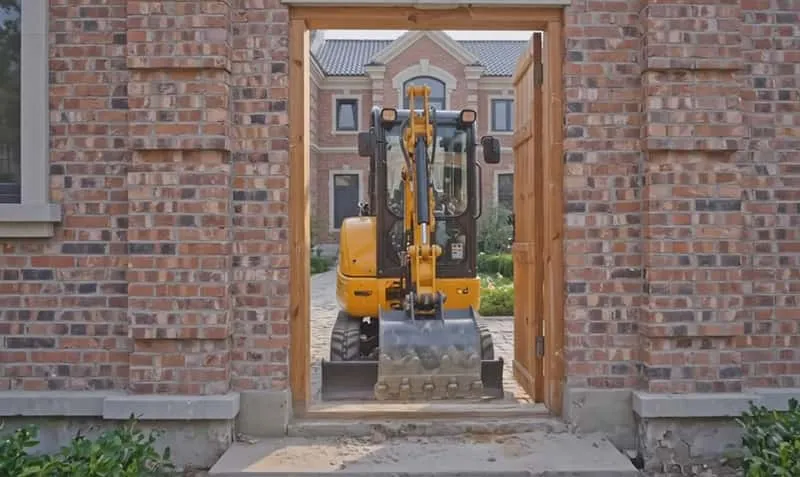
The range of machines covered here spans from 660 kg to 2,100 kg operating weight. At the lighter end, the priority is access — fitting through doors, not sinking in soft turf, clearing low roof beams. At the heavier end, the conversation shifts to traction under load, high-low speed transitions across long site hauls, and chassis adaptability for working across varying trench widths. Different weight classes need different things from an undercarriage, and the right configuration isn't always obvious from the spec sheet alone.
Ground Pressure, Track Width, and Why Both Matter on Soft Sites
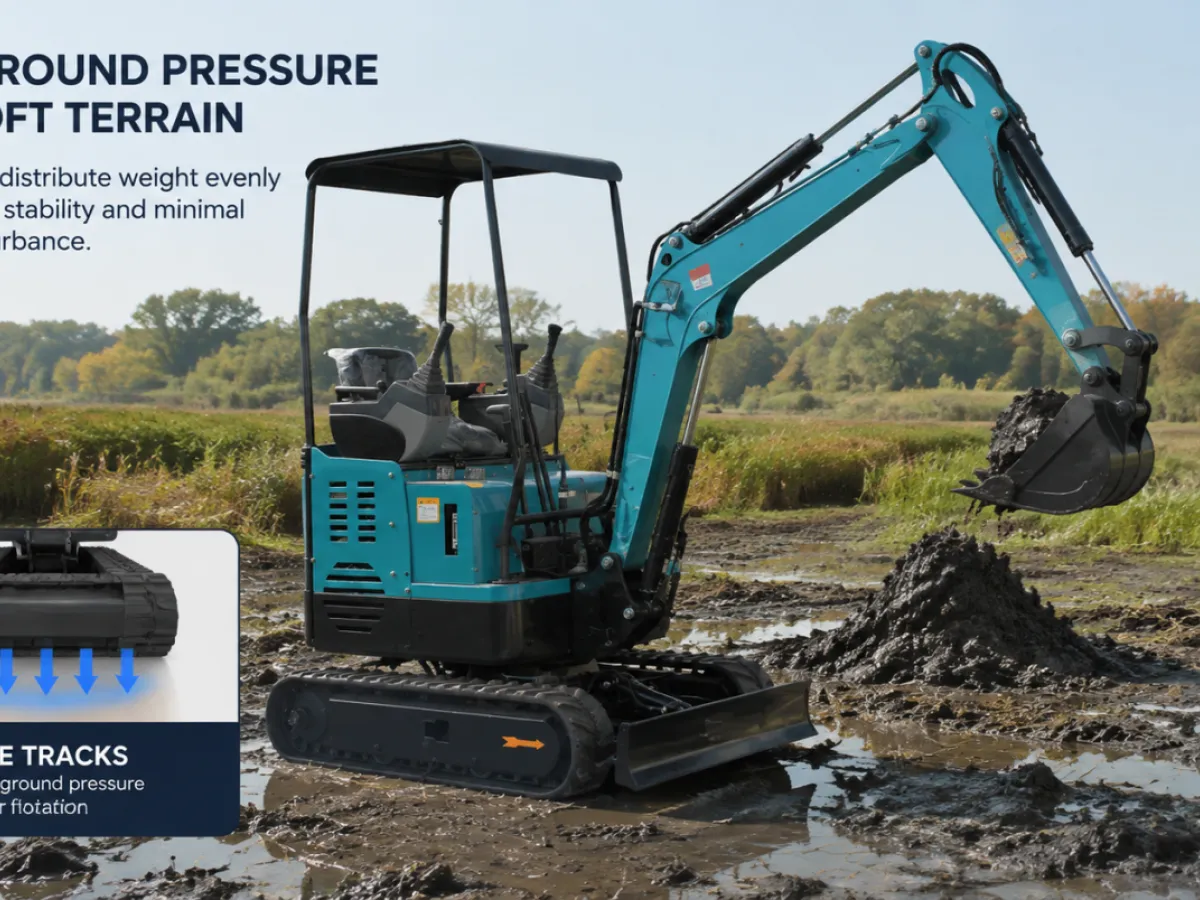
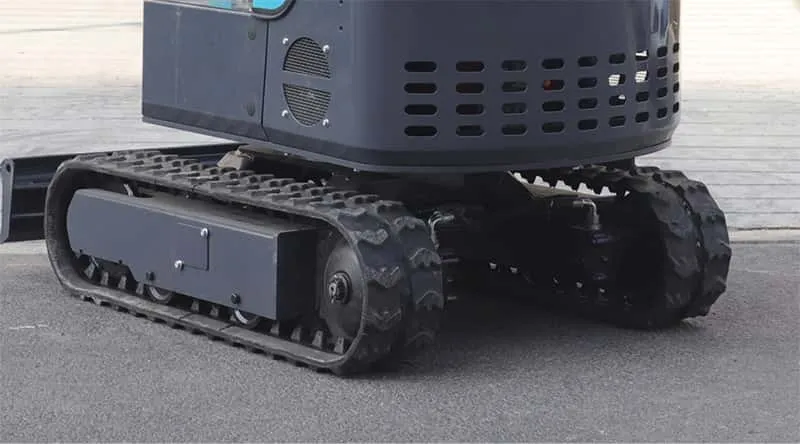
A mini excavator rubber track spreads machine weight across a contact patch determined by track length and width. The 06 series, at 660 kg and 700 mm track width, exerts ground pressure suitable for landscaped lawns and tiled floors without permanent damage. The 10 series at 1,000 kg with 930 mm wide tracks remains in a similar low-pressure category. These numbers matter enormously on soft or recently disturbed ground — a machine that sinks past its belly plates wastes the operator's morning and the client's patience.
As machines grow heavier — the 20 series at 1,850 kg, the 22 series at 2,100 kg — track width grows with them to maintain acceptable ground pressure. The 22 series offers a telescopic chassis that adjusts from 1,100 mm to 1,400 mm, allowing the operator to narrow the machine for transport and entry, then widen it on site for stability during heavy digging or breaking work. The 16 series and 25 series carry the same telescopic feature. This isn't just a convenience option — on sites where you're transitioning between passage through a 1.2-metre gate and working a 2-metre-wide trench, it's the difference between one machine or two.
Steel tracks are an available upgrade across most of the range. They make sense for pure rock or hardpack clay environments where the rubber tread would wear quickly. For mixed-terrain sites, rural renovation work, or any application where the machine moves across finished paving or tiled surfaces, the rubber track is the appropriate choice — and the engineering-grade compound used across the range holds up to serious abrasion better than the budget rubber found on cost-optimised imports.
Climbing Angles, Travel Speed, and the Slope You Didn't Account For
Every model in the range maintains a 30° climbing angle rating. That figure means more in practice than it sounds on paper: 30° is steep enough to handle most construction site spoil ramps, cut slopes, and embankment edges that machines encounter in normal work. What it doesn't mean is that the machine should be driven across a 30° traverse slope — side stability on traverses depends on load position and ground conditions, not just drive motor torque.
Travel speed is where the heavier C-series machines make a different design choice. The 16 series, 20 series, and 22 series all include a high-low speed travel mode. Low speed provides maximum drawbar pull for climbing soft slopes or pushing through deep mud. High speed — typically 0 to 6 km/h on these models — handles longer site traversals without the plodding pace that makes operators reluctant to reposition. The lighter Q-series machines at 1.5 to 1.8 km/h maximum are designed for compact site work where repositioning distance is short; the faster travel option on the heavier range reflects different job profiles where the machine covers more ground in a day.
Travel motor stall — the condition where the motor stops turning because demand exceeds available hydraulic torque — is most common when climbing steep slopes with a loaded bucket. Keeping the boom low and the bucket curled during travel reduces the machine's effective centre of gravity and reduces the hydraulic demand from the boom circuit. This leaves more flow available for the travel motors and reduces the risk of stall at the top of the incline.
Track Tension and Maintenance — What Goes Wrong and When
Mini excavator rubber track tension maintenance is the single most neglected undercarriage task on compact machines, and it's the leading cause of track derailment on sites where operators are used to steel-track large excavators that tolerate more abuse. Rubber tracks must be maintained at the manufacturer's specified tension — too tight causes premature steel core fatigue and idler bearing wear; too loose causes the track to jump the sprocket during sharp turns or when the machine backs up against resistance.
Track tension adjustment on the models covered here uses a grease-nipple tensioner accessed from the side of the track frame. Checking tension before each shift takes thirty seconds and looks like this: the sag at the mid-point of the track's lower run should be within the manufacturer's spec (typically 10–20 mm depending on model size). If mud or clay has packed into the drive sprocket pockets, track tension will feel correct but the packed material is preventing proper meshing — clean the sprocket before checking tension.
Track replacement intervals depend almost entirely on surface type. On concrete and asphalt, expect 800 to 1,200 hours before the tread pattern is worn to the wear indicator. On soil and soft aggregate, 2,000+ hours is achievable with proper tension maintenance. The wear-resistant compound used on these tracks handles mixed-surface work better than basic rubber, but no compound eliminates the fact that abrasive surfaces are the enemy of rubber tread life.
Choosing the Right Undercarriage Configuration for Your Work Profile
If the majority of work involves access through gates, corridors, or between buildings — and the distances travelled on site are short — the 06 series or 10 series rubber track configuration is the practical answer. Compact footprint, low ground pressure, and simple fixed-width chassis make these machines easy to load, transport, and deploy.
If the work profile involves sloped sites, wet ground, and the need to work at varying digging widths — a trencher job where the trench might be anywhere from 1.0 m to 1.6 m wide — the 16 series or 22 series with telescopic undercarriage provides the chassis adaptability that fixed-width machines cannot. The few minutes spent adjusting chassis width on arrival at each dig zone is paid back in machine stability and reduced risk of track derailment during the dig.
For buyers sourcing a compact excavator for rental fleet use, where machines see different operators and different surfaces every week, the engineering rubber track with steel core reinforcement is worth specifying from the start. The upfront cost difference over basic rubber is small compared to the avoided track replacement that comes from a machine that gets used hard across concrete yards, gravel paths, and mud with equal frequency.