



How Operator Control Habits Influence Skid Steer Attachment Performance on Real Job Sites
On many construction and maintenance sites, equipment performance is often evaluated based on machine specifications or attachment design. However, practical experience shows that operator control habits play an equally important role in determining how effectively a skid steer attachment performs during daily operations. Even well-designed attachments can underperform when control inputs are inconsistent or poorly timed.
Understanding how operator behavior interacts with hydraulic response, machine balance, and attachment workload helps contractors improve productivity without changing equipment. In real working conditions, small adjustments in operating habits frequently produce larger performance improvements than hardware upgrades.
The Relationship Between Operator Inputs and Hydraulic Response
A skid steer loader relies heavily on hydraulic flow stability. Every attachment—whether a bucket, sweeper, or grapple—responds directly to operator inputs transmitted through the hydraulic system. Unlike mechanical tools, hydraulic attachments amplify operator actions, meaning abrupt movements can quickly translate into instability at the attachment level.
Many new operators assume faster joystick movement results in higher efficiency. In practice, sudden inputs often create pressure spikes inside the hydraulic circuit. These spikes cause attachments to react aggressively, reducing control precision and increasing mechanical stress.
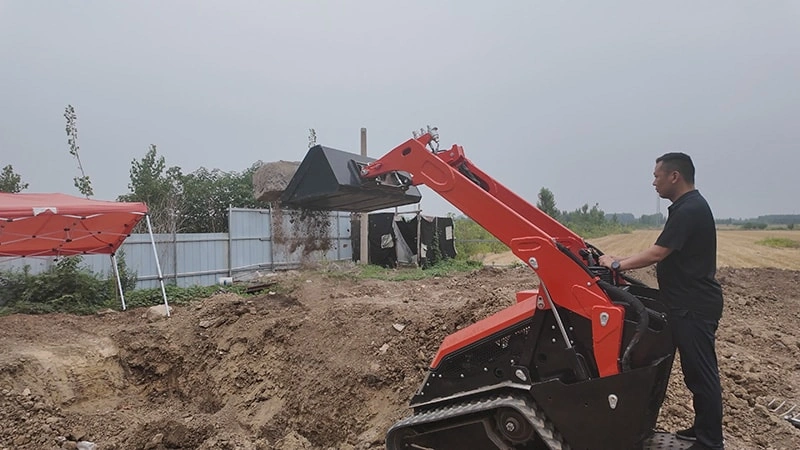
Experienced operators instead apply progressive control inputs. Smooth acceleration and gradual directional adjustments allow hydraulic pressure to stabilize, enabling attachments to maintain consistent motion. This is particularly noticeable when using a skid steer bucket during repetitive loading cycles, where stable motion improves both accuracy and cycle time.
Why Consistency Matters More Than Speed
Job site efficiency is rarely determined by peak movement speed. Instead, it depends on how consistently tasks are repeated over time. Attachments function best when motion patterns remain predictable, allowing hydraulic flow and machine balance to stabilize.
For example, during material loading operations, operators who maintain consistent lift and tilt timing achieve smoother bucket filling. Inconsistent timing forces the attachment to compensate repeatedly, increasing fuel consumption and operator fatigue.
Consistency also improves attachment lifespan. Repeated shock loading—often caused by aggressive control habits—accelerates wear on pins, hydraulic seals, and mounting components. Contractors sometimes attribute premature wear to attachment quality when the underlying issue is operational technique.
By maintaining uniform motion cycles, operators reduce stress across the entire machine-attachment system.
Machine Balance and Attachment Control
Operator habits directly affect machine stability. Skid steer loaders have compact wheelbases, meaning weight transfer occurs quickly during lifting and turning. Attachments amplify these shifts because they extend the machine’s working radius.
When operators lift loads too quickly or turn sharply while elevated, the machine’s center of gravity changes abruptly. This affects traction and can reduce attachment accuracy. Controlled operators anticipate these balance changes and adjust movements accordingly.
A common example appears during pallet handling tasks. Smooth lifting followed by gradual travel acceleration keeps loads stable and prevents oscillation. Abrupt acceleration, on the other hand, forces hydraulic compensation and reduces control precision.
Balanced operation allows attachments to work as intended rather than constantly correcting instability.
The Hidden Impact of Operator Fatigue
Operator fatigue is an often overlooked factor influencing attachment performance. As fatigue increases, control inputs typically become less precise. Movements grow sharper, reaction times slow, and hydraulic commands become inconsistent.
Over long workdays, even skilled operators may unintentionally introduce inefficiencies. Contractors who rotate tasks or schedule brief pauses often notice improved attachment performance without any mechanical adjustment.
Ergonomic seating position and visibility also contribute to control consistency. When operators maintain clear sightlines to the attachment edge, they rely less on corrective movements. Reduced correction leads to smoother hydraulic operation and improved workflow continuity.
Developing Efficient Control Habits
Efficient operator habits are usually developed through repetition rather than formal training alone. However, several practical principles consistently improve attachment performance:
Begin movements gradually rather than abruptly;Maintain steady joystick pressure during repetitive cycles;Avoid simultaneous extreme motions (lifting and sharp turning);Allow hydraulic systems brief stabilization periods between heavy actions;Observe attachment behavior instead of reacting only to machine motion.These habits help operators work with hydraulic dynamics rather than against them.
Over time, machines operated with controlled inputs demonstrate more predictable performance, reduced maintenance interruptions, and improved fuel efficiency.
Attachment Performance as a System Outcome
It is useful to view attachment performance as the result of a system rather than a single component. The system includes:Machine hydraulic characteristics;Attachment design;Job site conditions;Operator control behavior.
While manufacturers optimize equipment design, daily performance ultimately depends on how operators interact with the machine. Skilled control transforms standard equipment into highly efficient tools, whereas inconsistent operation limits even advanced attachments.
This systems perspective explains why identical machines on the same site may produce different results depending on who operates them.
Practical Benefits for Contractors
Improving operator control habits provides several measurable advantages:More consistent attachment productivity;Reduced hydraulic stress and maintenance frequency;Improved fuel efficiency during repetitive tasks;Enhanced safety through smoother machine behavior;Longer attachment service life;Importantly, these benefits require no additional investment in equipment. Adjusting operating technique often delivers immediate improvements.
For contractors managing compact job sites, where skid steer loaders perform multiple roles throughout the day, refined control habits significantly enhance overall workflow efficiency.
Conclusion
Attachment performance is not determined solely by engineering design. On real job sites, operator behavior forms a critical link between machine capability and practical results. Smooth, consistent control inputs allow hydraulic systems to function efficiently, maintain machine balance, and support predictable attachment motion.
By recognizing the influence of operator habits, contractors can improve productivity using existing equipment while reducing unnecessary wear and downtime. In daily operations, disciplined control often proves more valuable than increased machine power.