



Streamlining Small Projects with Skid Steer Versatility
Small projects often require the same mix of tasks as larger jobs—excavation, staging, backfilling, and cleanup—but with fewer people, less space for equipment, and limited time to reset the site between steps. That combination makes efficiency less about owning more machines and more about keeping the work moving with minimal interruptions. A skid steer loader fits these conditions because one operator can shift from bulk material handling to pallet staging and then to surface cleanup using the same base machine and a small set of attachments. For contractors working on compact jobs such as minor grading, small pad prep, landscape renovation, driveway edge repairs, or utility patch work, the skid steer can function as the “support machine” that keeps materials, access, and site order under control.
Versatility does not mean performing every task at once. It means choosing the few attachments that cover the project’s core work and using them in planned blocks—so the machine stays productive and attachment changes happen at natural break points. On small sites, the hidden time losses are often small but frequent: stopping to decide what to do next, moving an attachment from a far corner of the site, or swapping tools multiple times for single short tasks. A more reliable approach is to plan the job as phases that match the attachments. When the operator and crew follow that plan, the skid steer can maintain a steady rhythm instead of operating in short, inefficient bursts that add up to a longer day.
Matching Attachments to Project Scope
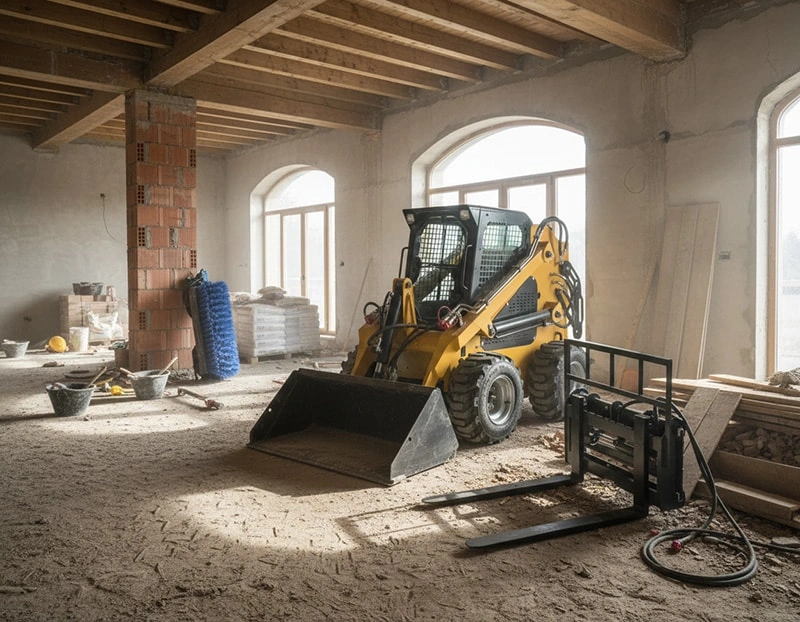
A skid steer bucket typically covers excavation and material handling, while sweepers and forks support cleanup and logistics. The bucket is usually the starting point because it can handle the widest range of work: moving soil, relocating aggregate, collecting loose debris, and back-dragging to shape small areas before fine finishing. On many small projects, a bucket phase is most effective when it is treated as a complete block—move the material, shape what needs shaping, and leave the site ready for the next step—rather than bouncing between bucket work and other activities.
Pallet forks are often the next “high value” attachment when projects involve deliveries or repeated transport. Palletized materials (bagged product, blocks, boxed parts, or tool cages) can be placed where crews will use them, instead of being set down wherever a truck can reach. This reduces re-handling and helps keep travel lanes clear. On tight sites, correct staging can matter as much as speed: a pallet placed in the wrong location can block access, force extra moves, or disrupt another trade’s working area.
Sweepers support the finish of the workflow, especially when the same paths are used repeatedly throughout the day. Even efficient loading and transport can leave spilled aggregate, tracked mud, and scattered debris that makes the site harder to navigate and less safe. Scheduling cleanup as a planned phase (or as short, predictable cleanup windows) helps maintain access for people, carts, and delivery vehicles. It also helps protect finished edges, such as curbs, sidewalks, or hardscape borders, where loose material can be tracked onto completed surfaces and create rework later.
Choosing attachments that align with the actual project scope prevents overcomplication. Bringing too many specialized tools can increase staging requirements and create unnecessary changeovers. A simple selection rule is to start with what drives the schedule: if the job is mostly bulk movement and shaping, prioritize the bucket and one finishing tool. If the job is delivery-heavy, prioritize forks and a method to maintain site order. If surface cleanliness and access are a constant issue, plan for a sweeper phase rather than treating cleanup as an afterthought.
Simplifying Daily Operations
By relying on one machine, crews reduce coordination time, trailer transport needs, and on-site traffic conflicts—especially when access is tight and the work area must remain open for homeowners, inspectors, or other trades. With fewer machines on site, the workflow becomes easier to control: fewer parking conflicts, fewer blocked corridors, and fewer moments where one machine’s movement interrupts another crew’s task.
Operator familiarity also plays a measurable role. When the same operator runs the same skid steer over several days, control inputs and travel patterns become more consistent. That consistency helps with repeatable tasks such as spreading base material in layers, back-dragging to a similar finish, moving pallets to standard staging zones, and keeping access lanes open. Familiarity reduces “small errors” that create downtime later—such as leaving piles in the wrong place, creating uneven transitions that require regrading, or tracking loose aggregate onto areas that must stay clean.
Planning attachment use in blocks also helps reduce unnecessary stops. When the bucket phase is finished, the operator can perform a single, deliberate changeover to forks for staging and placement, and then later switch once more to sweeping for cleanup and reset. This prevents repeated switching that consumes time and increases the chance of connector contamination or minor fit issues that slow the workday. Staging attachments in a consistent, easy-to-reach location also matters on small sites; a well-chosen staging corner keeps the changeover process quick and keeps attachments out of traffic paths.
Practical Efficiency for Small Jobs
Streamlining does not involve eliminating tasks; it involves organizing them intelligently: complete bulk movement first, stage materials second, then finish with surface cleanup and a final pass for access and safety. With proper attachment selection and workflow planning, skid steer loaders help small projects progress smoothly from start to completion. The machine’s value comes from staying useful across the entire day—not by doing everything at once, but by supporting each phase with the right tool at the right time and leaving the site in a workable condition for whatever comes next.