



Supporting Multi-Trade Job Sites with a Single Skid Steer Loader
Multi-trade job sites often operate within limited space and tight schedules. Concrete crews may need clear access for formwork and pouring, utility teams need room to open narrow trenches or access points, and landscaping crews often work along edges that must remain clean and undisturbed. When several trades overlap, delays commonly come from logistics rather than labor: pallets placed in the wrong zone, blocked travel lanes, scattered debris, or repeated “small moves” that interrupt primary work. In these conditions, equipment that can change roles quickly—without taking up extra staging space—helps keep the site moving.
A skid steer loader supports these environments by serving multiple roles throughout the day. Rather than dedicating machines to individual trades, contractors often rely on one skid steer to assist all teams as needed. This approach reduces site congestion and simplifies coordination because there is one central machine assigned to “support flow” tasks: moving materials from drop-off to work faces, relocating small stockpiles, maintaining access lanes, and restoring order after a work phase. The goal is not to replace specialized equipment on every project, but to cover the frequent short-duration needs that otherwise pull crews away from skilled work.
Adapting to Changing Site Needs
A skid steer bucket supports excavation and material relocation for one crew, while pallet forks assist another with transporting supplies or equipment. Early in the day, the bucket can be used to relocate aggregate, clean up loose debris piles, or back-drag small areas so crews can set grade lines or start layout. As deliveries arrive, switching to pallet forks enables quick placement of palletized materials—bagged product, block, pavers, boxed components, or tool cages—directly to the point of use. This reduces re-handling and keeps materials out of travel corridors where they become bottlenecks.
Later, a sweeper can restore order after work phases are completed. Material movement and cutting tasks often create scattered gravel, mud tracks, packaging, and offcuts. If these are left until the end of the day, they accumulate into slip hazards and slow down wheeled carts, lifts, and foot traffic. Integrating short cleanup windows into the daily plan helps maintain safe walkways and clear access for the next trade. It also supports quality control: a cleaner site makes it easier to spot layout markings, detect surface issues, and keep finished edges from being damaged by tracked material.
The key advantage is adaptability without disruption. When the operator follows a planned support schedule—bucket tasks grouped together, fork transport grouped together, and cleanup performed at defined intervals—the skid steer can move between trades smoothly. Instead of repeated mid-task switches, the machine becomes a predictable shared resource that crews can request at known times, reducing conflict and idle waiting.
Reducing Equipment Overlap
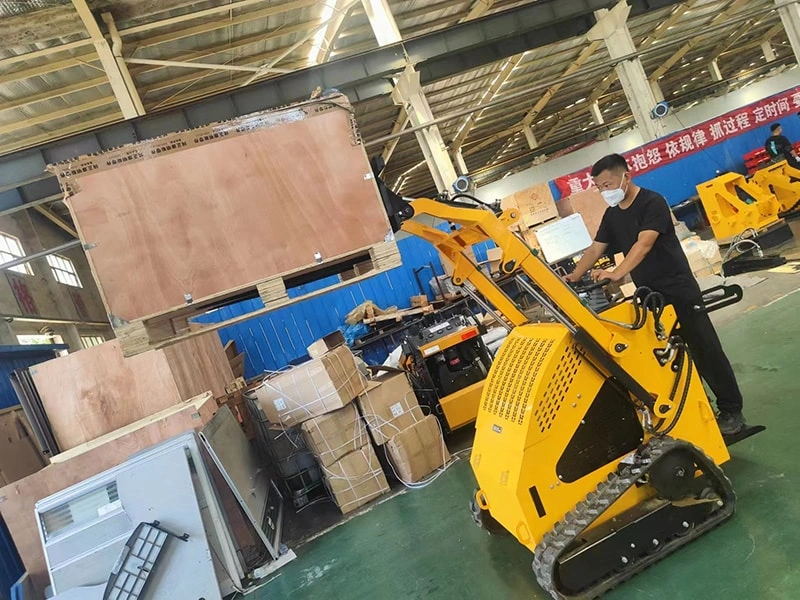
Using one machine to support multiple trades reduces the need for additional equipment staging areas. On compact sites, each extra machine requires space to park, turn, and maintain safe separation from pedestrians and work zones. When multiple machines overlap, traffic becomes the limiter: narrow corridors clog, reversing increases, and work faces are interrupted by equipment trying to pass. A single skid steer assigned to support tasks can reduce this overlap by concentrating “moves” into a controlled pattern rather than having several machines compete for the same lanes.
This is especially valuable when deliveries must be broken down and distributed in small batches. Instead of placing pallets everywhere and creating clutter, the skid steer can stage materials in a designated buffer zone, then deliver them in sequence to each crew. That sequence can follow priority: concrete placement areas first, utilities next, and landscaping edges after heavy traffic ends. Coordinating attachment use based on priority tasks keeps the skid steer productive without competing with other machines, and it helps the supervisor protect critical routes like emergency access, concrete truck approaches, or inspection paths.
Reducing overlap also helps prevent damage. Finished curbs, compacted base, and landscaped borders are more likely to be disturbed when multiple machines cross the same edge repeatedly. Keeping one support machine responsible for movement limits unnecessary passes and makes it easier to enforce “no-go” zones and consistent travel lines.
A Central Support Tool
In multi-trade environments, the skid steer loader acts as a shared resource rather than a dedicated machine. This role works best when the operator is integrated into the site’s coordination plan: knowing which trade has the next priority, where materials should be staged, and which areas must remain clean or protected. With that structure, the skid steer becomes the practical “connector” between trades—clearing space for one crew, delivering materials for another, and resetting the site so the next phase can start without delays.
As a central support tool, the skid steer can help standardize site routines. Materials can be delivered to consistent drop zones, moved to work faces in the order they will be installed, and repositioned as the project progresses. Short cleanup passes can be scheduled before inspections or before a finishing crew arrives. Even small improvements—keeping a narrow lane open, moving a single pallet out of the way, sweeping loose aggregate off a finished edge—protect schedule reliability across the day.
For multi-trade job sites, this approach turns a skid steer loader into an all-day coordination asset. With planned attachment use and clear task windows, one machine can support several crews, reduce equipment congestion, and keep progress steady without introducing unnecessary delays.